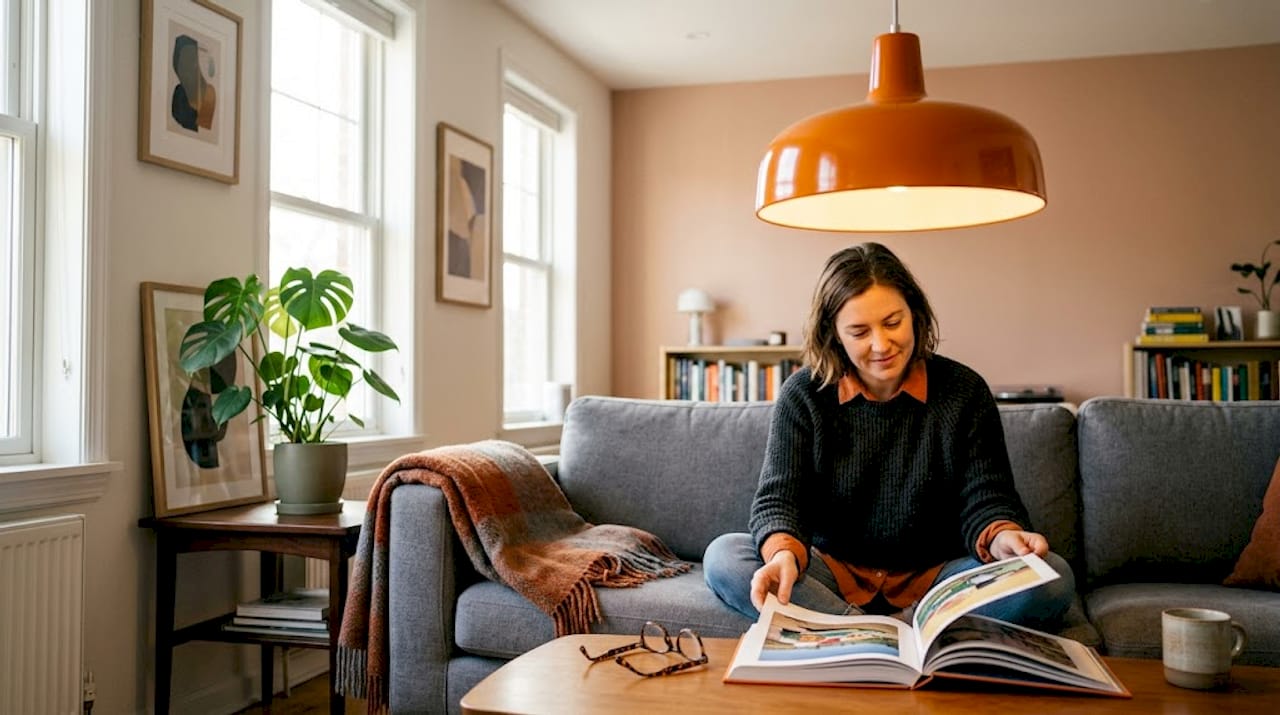
Ever walked into a room and felt an instant connection, a sense of curated elegance, or a cozy, inviting hug? Chances are, it wasn't just the furniture or the paint color doing all the heavy lifting. It was the lighting. And not just 'more' light, but intentional light. Most homeowners approach lighting the same way they approach buying groceries: more feels safer. More recessed lights, more lamps, more brightness. But flooding a room with uniform light is actually one of the fastest ways to drain it of personality and soul.
The real secret to a room that feels curated, layered, and alive lies in strategic accent lighting, which draws the eye to specific features and creates visual hierarchy and depth. This isn't just about illuminating a space; it's about sculpting it, telling a story, and guiding the eye. That shift, from quantity to intention, is what separates a forgettable room from one that stops you in your tracks, sparking joy and inspiring conversation.
At Find a Lamp, we believe lighting is the unsung hero of interior design. It has the power to transform bland spaces into vibrant sanctuaries, simply by knowing where and how to shine. Let's dive deep into the magic of lighting focal points and unlock your room's full potential.
Table of Contents
- What are lighting focal points?
- Key lighting techniques for creating focal points
- Adapting focal points for small and flexible spaces
- Common mistakes and how to avoid them
- A fresh perspective on lighting focal points
- Find the perfect lighting for your focal point
- Frequently asked questions
Key Takeaways
| Point | Details |
|---|---|
| Creates visual interest | Lighting focal points help highlight what matters most and add depth to your rooms. |
| Use evidence-based placements | Where you position downlights, sconces, or pendants determines their impact. |
| Adapt for any room | Whether you have a small space or a multifunctional area, you can use lighting focal points to great effect. |
| Avoid common mistakes | Steering clear of over-lighting or misplacing fixtures results in better ambiance and design. |
What are lighting focal points?
To dig deeper, let’s break down what lighting focal points really are and why they're so crucial for creating dynamic, engaging interiors.
A lighting focal point is any area of a room where light is deliberately concentrated to draw attention, create depth, or establish a visual anchor. Think of it as the room’s main character, the element everything else orbits around. It could be a sculptural pendant over a dining table, a picture light grazing a large canvas, or a pair of sconces flanking a fireplace. The fixture or feature itself becomes the destination your eye travels to first. It's about creating a "visual hierarchy" within a space, telling the eye where to look and what to appreciate first. Architectural Digest often showcases homes where this principle is masterfully applied, demonstrating how light can transform even the simplest elements into breathtaking features.
Lighting focal points refer to the strategic use of accent lighting to draw attention to specific architectural features, artwork, furniture, or statement fixtures, creating visual hierarchy and depth in interior spaces. That definition is worth sitting with, because it reveals something important: focal point lighting is not about brightness. It’s about contrast, direction, and intention. It's about creating pockets of illuminated interest that pull you into the room and make you want to explore.
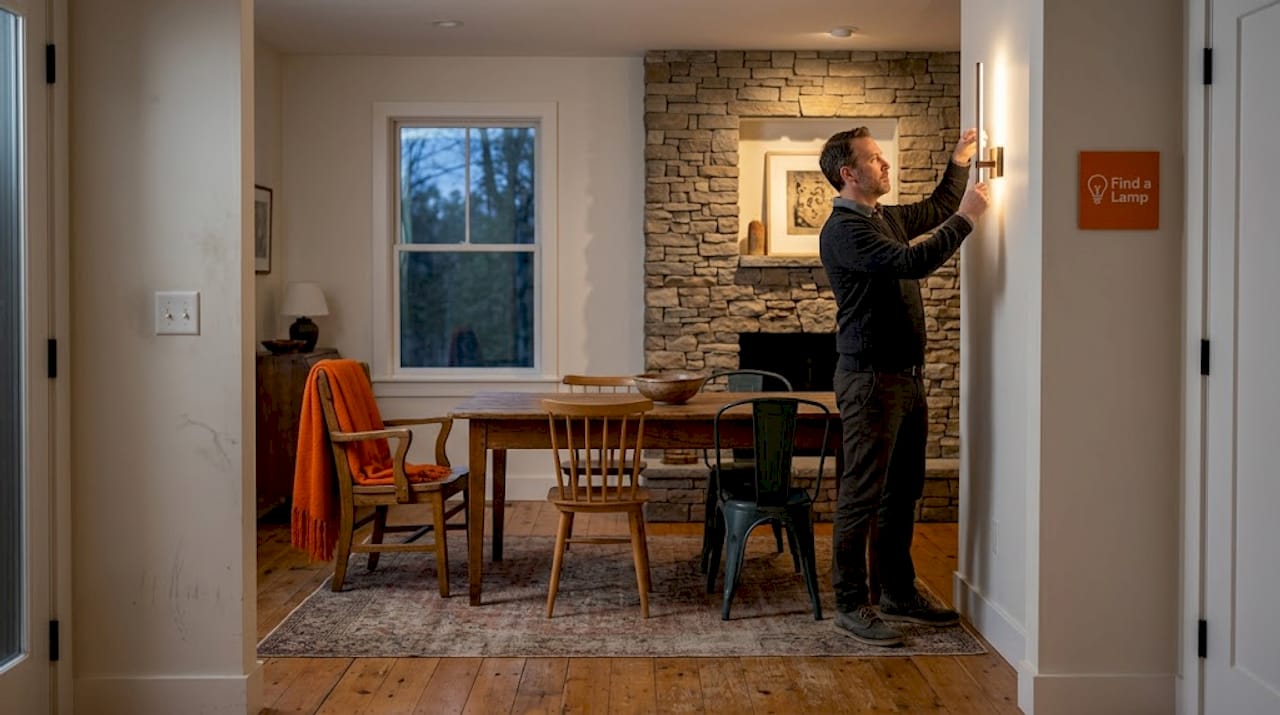
The difference between focal point lighting and ambient lighting basics is significant. Ambient light fills a room evenly, reducing shadows and making spaces feel safe and navigable. It’s the foundational layer. Focal point lighting, by contrast, introduces shadow, contrast, and drama. It tells a story, adds intrigue, and makes a space feel alive. Without it, even the most beautifully furnished room can feel flat, like a stage with no spotlight, or a painting without a clear subject.
Here’s a quick look at how focal point lighting works across different room types:
| Room | Common focal point | Best fixture type |
|---|---|---|
| Living room | Fireplace or large artwork | Picture light, sconces, accent spotlights |
| Dining room | Table centerpiece | Pendant or chandelier, sometimes wall sconces |
| Bedroom | Headboard wall | Wall sconces, reading lights, subtle uplighting |
| Entryway | Console table, mirror, architectural arch | Pendant, statement lamp, recessed accent lights |
| Home office | Shelving, desk area, inspiring artwork | Adjustable task lamp, linear shelf lighting |
| Kitchen | Island, open shelving, specific artwork | Pendant lights, under-cabinet lighting, track lighting |
Some of the most compelling focal points in a home include:
- Architectural features like exposed brick walls, coffered ceilings, arched doorways, or textured wall panels.
- Statement furniture pieces such as a vibrant velvet sofa, a sculptural bookcase, or an antique cabinet.
- Art collections or a single oversized canvas that demands attention.
- Mantels, niches, and built-ins that offer natural recesses for light play.
- Decorative mirrors that reflect and amplify light, potentially creating a secondary focal point.
- Indoor plants or vertical gardens, which can be dramatically lit to emphasize their organic forms.
Our room lighting guide goes deeper into how each room benefits from its own focal point strategy, because what works in a kitchen is very different from what works in a moody reading nook. Understanding these nuances is key to mastering the art of lighting design.
“A room without a focal point is like a sentence without a subject. The eye doesn’t know where to land, so it lands nowhere.”
That instinct, to give the eye somewhere to go, is what separates rooms that feel designed from rooms that simply feel furnished. It’s about creating a conversation between the light and the space, inviting you to engage with its beauty.
Key lighting techniques for creating focal points
With the basics covered, it’s time to outline the most effective techniques used by designers to turn ordinary spaces into extraordinary experiences. This isn't just about picking a pretty lamp; it's about understanding how light interacts with your space.
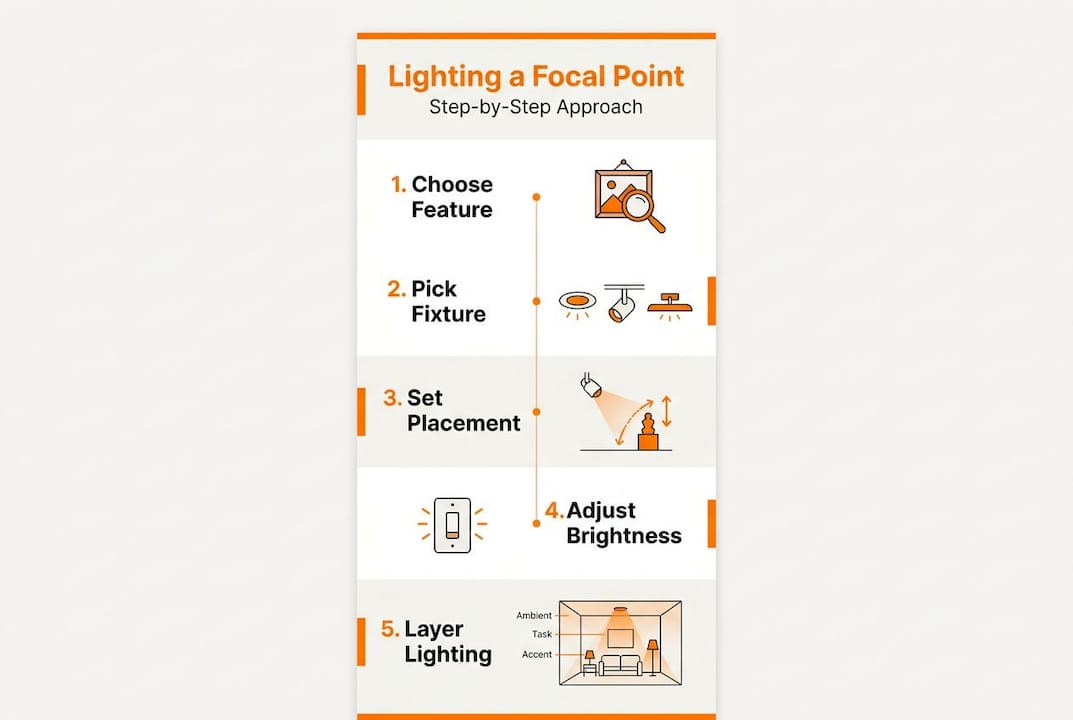
The most impactful focal points are rarely created with a single fixture. They’re built through layering, a deliberate combination of ambient, task, and accent lighting that gives a room both function and atmosphere. Think of it as painting with light, adding layers to create depth and dimension. Experts at Lightology often highlight the importance of layering to achieve a truly sophisticated lighting scheme.
Here’s how to approach it systematically:
-
Start with your anchor. Identify the one feature you want to celebrate, whether it’s a treasured piece of art, a magnificent fireplace, a dramatic piece of furniture, or even a stunning view outside a window. Everything else should support it, not compete with it. This anchor will dictate the type and intensity of the light you use.
-
Choose the right fixture for the job. Different fixtures are designed for different effects:
- Recessed downlights: Work beautifully when positioned 12-18 inches from walls, using a narrow beam angle (e.g., 20-30 degrees) to create a dramatic grazing effect that highlights texture and depth, making walls feel textured and alive.
- Wall sconces: Belong at eye level, roughly 60-72 inches from the floor, so they frame a feature without towering over it. They provide a soft, ambient glow that adds warmth and can highlight architectural details or flank a mirror beautifully.
- Pendants and chandeliers: Over dining tables, they should hang 30-36 inches above the surface, close enough to feel intimate, high enough to allow conversation across the table. In entryways, they create a grand statement and draw the eye upwards.
- Picture lights: Purpose-built for art, mounted above the canvas, casting a warm wash that brings color and texture forward without glare. They are essential for any art collector.
- Floor lamps: Offer versatile accent and task lighting. An arc floor lamp can create a sculptural focal point over a seating area, while a slim column lamp can illuminate a dark corner, adding a soft glow.
- Table lamps: Add intimate pools of light, perfect for highlighting decorative vignettes on console tables or providing task lighting for reading.
-
Layer your sources. A single overhead fixture, no matter how beautiful, creates one-dimensional light. Combine it with floor lamps, table lamps, or sconces to build depth and visual interest. Think of it the way a photographer thinks about lighting a portrait: key light (your focal point), fill light (ambient), and rim light (accent) working together to create a rich, multi-faceted image.
-
Control your color temperature. This is critical for mood. Warmer tones (2700K-3000K) feel intimate, cozy, and flattering, ideal for living rooms, bedrooms, and dining areas. Cooler tones (3500K-4000K) feel crisp, focused, and energizing, better for offices, kitchens, or bathrooms where task lighting is paramount. Mixing temperatures within a single room can feel jarring and disrupt the harmony, so choose a consistent palette for your primary layers.
-
Use dimming strategically. This is your secret weapon for atmosphere! A dimmable fixture transforms a focal point from daytime functional to evening atmospheric with the flick of a switch. Statement lighting examples show how the same chandelier can feel completely different at 100% versus 40% brightness, allowing you to adapt the mood for any occasion.
Here’s a quick comparison of the most common focal point fixtures:
| Fixture type | Best placement | Visual effect | Ideal for |
|---|---|---|---|
| Recessed downlight | 12-18 inches from wall, narrow beam | Grazing shadows, texture emphasis | Architectural features, textured walls, art |
| Wall sconce | 60-72 inches high | Framing, warmth, ambient glow | Mantels, headboards, hallways, flanking mirrors |
| Pendant/chandelier | 30-36 inches above table, varied height for entryways | Drama, intimacy, statement piece | Dining rooms, entryways, kitchen islands |
| Picture light | Mounted above artwork | Color, texture emphasis, glare-free art illumination | Art walls, galleries, cherished photos |
| Floor lamp | Corner or beside furniture (e.g., sofa, armchair) | Softness, layering, sculptural element | Living rooms, reading nooks, defining zones |
| Table lamp | Console, side table, desk | Intimate glow, task lighting, decorative accent | Bedside tables, living room vignettes, desks |
Pro Tip: When layering lighting in a living room, start with your statement piece (a sculptural pendant or an arc floor lamp) and build outward. Consider how light will fall on different surfaces and objects. Check out our curated artistic living room lighting collection for fixtures that are designed to anchor a space with real visual authority. You can also explore lighting setups for each room to see how layering plays out in different contexts, ensuring every corner of your home feels intentionally designed.
Adapting focal points for small and flexible spaces
But what if your room isn’t a blank canvas, or you have to work with limited space? Fear not, small-space dwellers! The principles of focal point lighting are even more powerful in compact or multi-functional areas.
Small rooms and multi-use spaces present a genuinely different challenge. The instinct is often to maximize brightness, to fight the smallness with light. But that approach almost always backfires. Uniform, high-intensity lighting in a small room makes it feel like a hospital corridor, not a home. It flattens surfaces and eliminates any sense of coziness. The solution is counterintuitive: use fewer, stronger focal points, and prioritize flexibility.
In small rooms or multi-functional spaces, adjustable and smart lighting becomes essential. Over-reliance on recessed lighting actually flattens the space rather than opening it up. Asymmetrical placement, meanwhile, can enhance unique features that might otherwise go unnoticed, adding character without clutter. The goal is to make the space feel larger and more dynamic, not just brighter.
Here are the strategies we recommend for compact or flexible spaces:
- Prioritize vertical light. Uplighting or tall, slender floor lamps draw the eye upward, making ceilings feel higher and rooms feel larger. Wall-mounted sconces with an upward throw are also excellent for this effect, freeing up valuable floor space.
- Use one strong focal point instead of several competing ones. In a studio apartment, a single dramatic pendant over the dining area does more for the room than three different accent lights fighting for attention. This singular focus creates a clear destination for the eye, preventing visual chaos.
- Embrace adjustable fixtures. Track lighting with directional heads, pivoting wall sconces, or lamps with adjustable arms let you redirect light as your furniture arrangement changes, which is invaluable in rooms that serve multiple purposes throughout the day. Need to highlight your workspace during the day and a cozy reading nook at night? Adjustable fixtures are your friends.
- Avoid centering everything. Especially in small spaces, perfect symmetry can feel rigid and cramped. Asymmetrical placement—a lamp off to one side of a sofa rather than perfectly flanking it, or a single statement sconce—creates a more dynamic and interesting composition, making the space feel more curated and less 'boxed in'.
- Layer with portable lamps. Table lamps and floor lamps are your best friends in a small space because they’re movable, dimmable, and immediately transformative. They allow you to create distinct "zones" of light for different activities without permanent installations.
- Utilize reflective surfaces. Mirrors strategically placed can reflect light from your focal points, amplifying their effect and making the room feel larger and brighter without adding more fixtures.
Our collection of dimmable floor lamps is specifically curated for spaces where flexibility matters as much as aesthetics. And if your space has a playful, eclectic personality, the playful living room lighting collection offers fixtures that create focal points with personality rather than formality, proving that small doesn't have to mean boring.
Smart lighting also plays a growing role here. Smart light adaptation allows you to program scenes that shift the focal point of a room depending on the time of day or activity. Your home office corner becomes the focal point at 9 a.m. with crisp, focused light, and by 7 p.m., the warm glow near the sofa takes over for relaxation. That kind of intentional flexibility is what modern living demands, especially in urban environments.
Pro Tip: In a multi-use room, try mapping out two or three distinct “scenes” before you buy any fixtures. Knowing that your space needs to function as a workspace, a dining area, and a relaxation zone will help you choose adjustable fixtures and smart controls that can serve each scene without requiring you to rewire anything. Resources on lighting in small homes can help you visualize this approach before committing, ensuring every square foot is maximized.
Common mistakes and how to avoid them
Even with the best intentions, several common mistakes can diminish your desired effect and leave your room feeling less than spectacular. Understanding these pitfalls is the first step to truly mastering focal point lighting.
The most pervasive error we see is the over-reliance on recessed lighting. Recessed lights are practical, clean, and incredibly popular, but a ceiling full of them creates what designers call “flat light.” This shadowless, dimensionless wash makes even a beautifully furnished room feel like a showroom floor or an office waiting area, completely devoid of depth or warmth. Over-recessed lighting flattens spaces and eliminates the crucial contrast that makes a room feel rich and layered.
Here’s how to course-correct the most common focal point mistakes and elevate your lighting game:
-
Too many recessed lights, or using them as the sole light source. This is the cardinal sin of modern lighting. Replace or supplement with wall sconces, pendants, floor lamps, and table lamps. If you can’t remove existing recessed fixtures, at least dim them significantly and let accent lighting do the heavy lifting. The goal is contrast and drama, not uniform coverage. Think of recessed lights as supporting players, not the stars of the show.
-
Fixtures at the wrong height or angle. Placement is everything! A sconce mounted too high feels disconnected from the furniture below it. A pendant hung too low becomes a visual intrusion and a hazard, disrupting sightlines. Always measure before you mount, and use the guidelines above (60-72 inches for sconces, 30-36 inches above tables for pendants) as your baseline. For accent spotlights, experiment with beam angles and distances to achieve the perfect graze or wash on your focal point.
-
Ignoring asymmetry. Perfect symmetry in lighting can feel rigid, formal, and even a bit corporate. While it has its place, embracing asymmetry often feels more natural, dynamic, and interesting. A single sconce instead of two, a floor lamp on one side of a reading chair, or a cluster of pendants at varying heights can create a more organic and inviting composition. Our lighting mistakes room by room guide breaks this down with specific examples for each space.
-
Choosing fixtures for looks alone, neglecting function. A stunning sculptural pendant that throws light in the wrong direction, or a beautiful table lamp with a shade that blocks more light than it diffuses, is a design liability. Always check the light distribution pattern, bulb compatibility, and shade material before you buy. A fixture should enhance both the aesthetic and the function of your focal point.
-
Forgetting about the switch. This is a practical but often overlooked mistake. If your focal point fixture is hardwired to the same switch as your overhead lights, you lose the ability to use it independently. Wherever possible, put accent and focal point fixtures on separate circuits, or use smart plugs and smart bulbs to give yourself independent scene control. Dimmers are a non-negotiable for accent lighting.
-
Neglecting natural light. While we’re focusing on artificial lighting, don't forget how natural light interacts with your space. Position your focal points to be equally stunning in daylight and at night. Use window treatments to control natural light and prevent glare that might diminish the impact of your artificial focal points during the day.
“The most common lighting mistake isn’t choosing the wrong fixture. It’s not having a plan for what you want the light to do before you start shopping.”
That quote captures something we believe deeply. Lighting decisions made without a spatial strategy almost always result in rooms that feel unresolved, no matter how beautiful the individual fixtures are. Take the time to envision the mood, the drama, and the purpose of your light before you even browse for fixtures.
A fresh perspective on lighting focal points
After learning the how-to’s, it’s worth exploring what most guides miss: the art and intuition behind truly captivating lighting.
Most lighting guides, including many excellent ones, focus on the technical: the right heights, the right color temperatures, the right fixture types. That knowledge is genuinely useful, a solid foundation. But it can also create a kind of design paralysis, where homeowners are so focused on following the rules that they forget to ask what they actually want the room to feel like. Lighting isn't just about illumination; it's about emotion, atmosphere, and personal expression. Houzz often features articles that delve into the subjective, emotional impact of lighting, encouraging homeowners to trust their instincts.
Here’s our honest take: the best focal points we’ve ever seen don’t come from textbooks. They come from someone noticing that the afternoon light hits a particular corner of their living room in a way that makes everything glow, and then building a lighting scheme that recreates that feeling at 9 p.m. on a Tuesday. That’s the emotional intelligence of good lighting, and it’s rarely taught in a step-by-step guide.
Asymmetry and imperfection, two things most design guides quietly discourage, are often what make a room feel genuinely alive and personal. A single floor lamp positioned slightly off-center, a sconce that highlights a rough plaster wall rather than a perfectly smooth one, these choices feel human in a way that perfectly balanced, symmetrical schemes often don’t. Don't be afraid to break a "rule" if it feels right for your space and enhances its unique character.
We’d also push back gently on the idea that focal points should always be the most expensive or most dramatic element in a room. Sometimes the best focal point is the most personal one: a shelf of objects you’ve collected over years, lit from above with a simple picture light. Or a vintage lamp your grandmother owned, placed exactly where its warm glow feels most right. These are the focal points that tell a story, that evoke memories, and that truly make a house a home. Our room-by-room lighting perspective explores how personal context shapes lighting decisions in ways that no formula can fully capture.
Ultimately, the technical rules exist to serve the emotional outcome, not the other way around. Use them as a foundation, then trust your instincts about what makes your specific room feel like yours. Experiment, play, and allow your lighting to evolve with your life. After all, your home is a reflection of you, and its light should be too.
Find the perfect lighting for your focal point
Armed with new knowledge and a fresh perspective, here’s where to put your ideas into action and bring your vision to life.
Ready to create a focal point that genuinely transforms your space, infusing it with personality, depth, and that elusive 'wow' factor? We’ve built Find a Lamp specifically for moments like this, when you know what you want a room to feel like but need help finding the perfect fixture that will get you there.

Forget endless scrolling and decision fatigue. Upload a photo of your room to Find a Lamp, and our AI will analyze your space, identify the strongest focal point opportunities, and recommend fixtures from our curated catalog that match your style, scale, and budget. Whether you're aiming for dramatic flair, subtle elegance, or playful charm, our engine understands the nuances of design.
Browse our lamps for living room collection for statement pieces with real visual authority, or explore our modern dimmable floor lamps for flexible focal point solutions that adapt to how you actually live. Your perfect focal point fixture is closer than you think, and our AI is ready to help you find it, making your lighting design journey effortless and inspiring.
Frequently asked questions
What does a lighting focal point do in a room?
A lighting focal point draws attention to a specific feature, creating visual interest and guiding the eye through a space. As accent lighting experts note, it establishes visual hierarchy and depth that uniform lighting simply cannot achieve, making a room feel more dynamic and curated.
How do you choose what to highlight with accent lighting?
Choose architectural details, beloved artwork, unique furniture, or any personal elements you want to showcase. The best candidates are features with texture, color, or personal significance that reward closer attention and contribute to the room's overall story.
Are there rules for placing lighting fixtures for focal points?
Yes, there are helpful guidelines. Downlights work best at 12-18 inches from walls with a narrow beam, sconces at 60-72 inches high, pendants 30-36 inches above tables, and picture lights mounted directly above artwork for the most flattering wash of light. These are starting points to ensure optimal effect.
What if my room is very small or has multiple uses?
In small or multi-use rooms, focus on fewer but stronger focal points with flexible, adjustable, or smart fixtures. Prioritize vertical lighting to draw the eye up, and use portable lamps to create distinct zones. One well-placed dimmable lamp will do more for a small room than five competing accent lights pulling in different directions.
Can a light fixture itself be a focal point?
Absolutely! A sculptural chandelier, an oversized pendant, or a uniquely designed floor lamp can serve as a stunning focal point even before its light is cast. These "statement fixtures" draw the eye by their form and design, acting as both an aesthetic anchor and a light source.