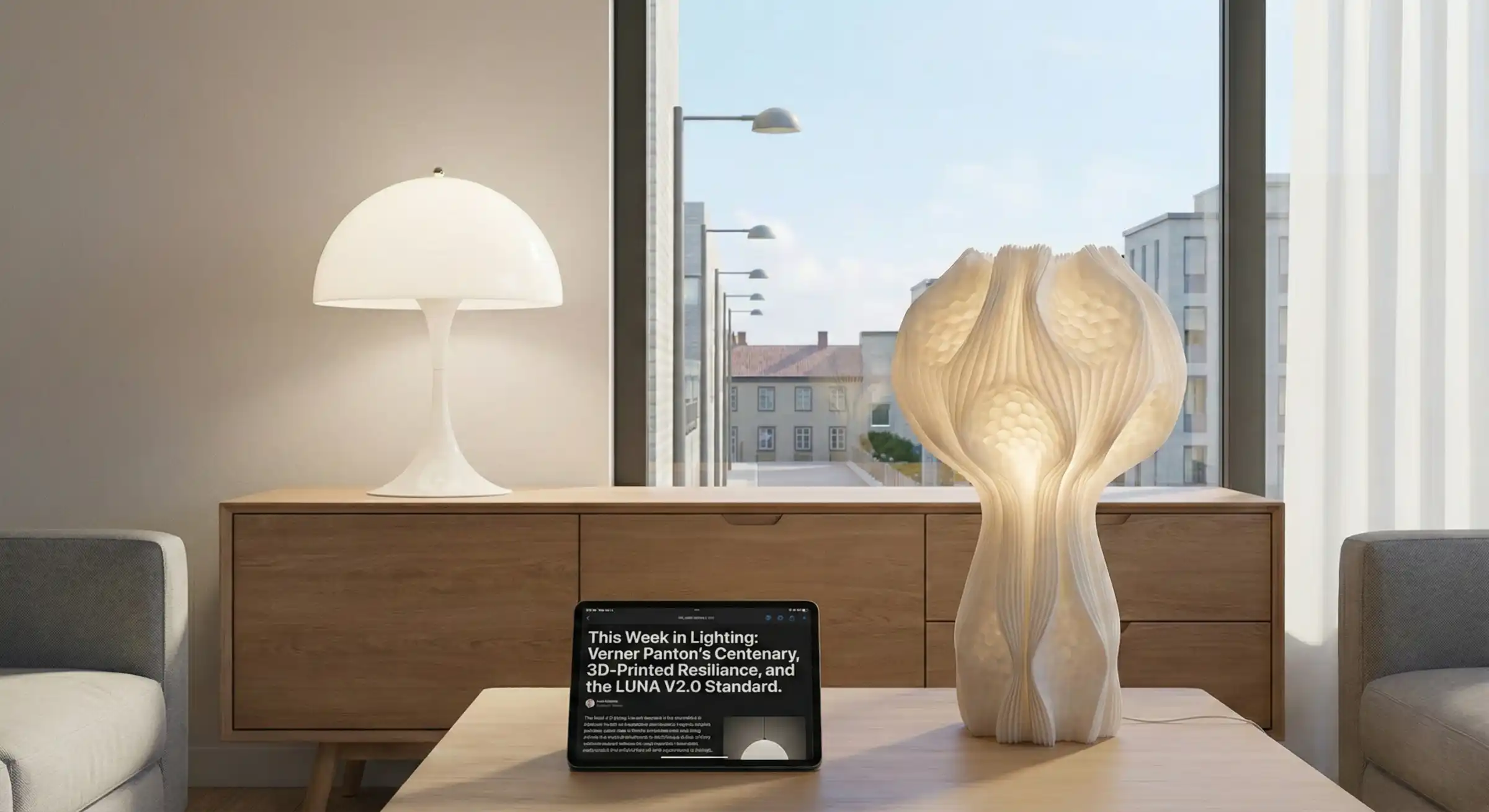
Welcome to the mid-February edition of "This Week in Lighting," your curated source for all things illuminating! This week, we're witnessing a fascinating convergence of past, present, and future. We're celebrating a design icon's centennial while simultaneously embracing cutting-edge technology and crucial sustainability standards that will shape the ecological impact of light for decades to come.
1. The Centenary of a Visionary: Verner Panton at 100
This February 13th, the design world paused to celebrate what would have been the 100th birthday of the one and only Verner Panton. Born in 1926, Panton's impact on design is undeniable. He remains a foundational figure in modern Functional Art, blurring the lines between practical lighting and sculptural masterpieces. As Dezeen beautifully illustrates in their retrospective, Panton was a true visionary, fearlessly experimenting with saturated colors, unconventional materials, and biomorphic shapes long before they became mainstream trends. Think psychedelic patterns, molded plastic furniture, and a healthy dose of playful rebellion – that's Panton in a nutshell!
But Panton's influence goes beyond aesthetics. He understood the power of light to evoke emotion and transform spaces. His iconic pieces, such as the Flowerpot and Panthella lamps, are more than just light sources—they are design statements, precursors to the Emotional Minimalism we're seeing championed today. These lamps aren't just functional; they spark joy, create atmosphere, and tell a story. Design enthusiasts are revisiting his work this week, drawing inspiration from his bold approach and remembering that light should elicit a visceral, joyful reaction.
Consider the Panthella lamp, for example. Its gently curved shade and soft, diffused light create a calming and inviting ambiance. It's a perfect example of how a single lamp can transform a room into a sanctuary. Or the Flowerpot lamp, with its playful, overlapping spheres, injecting a dose of fun and whimsy into any space. These designs are timeless, proving that good design transcends trends and continues to resonate with audiences across generations. To learn more about Panton's enduring influence, explore resources like the official Verner Panton website for a deep dive into his extensive portfolio.
2. Innovation Spotlight: The 3D-Printed 'POPPY' Lamp
Seamlessly merging mid-century organic forms with cutting-edge 2026 technology, Unlit Design has unveiled the captivating POPPY lamp. This table lamp is a striking illustration of how 3D printing is being refined to create intricate textures that mimic the delicate beauty of textiles. Forget clunky, angular 3D-printed objects; the POPPY lamp showcases the technology's potential for creating graceful, organic forms.
- The Resilience Motif: Inspired by the poppy flower, a symbol of remembrance and resilience, the lamp's design incorporates pleats and polygons to evoke a sense of 'calm presence.' The poppy's ability to thrive in challenging environments is reflected in the lamp's durable construction and timeless design.
- Sustainable Craft: By leveraging modern additive manufacturing techniques, Unlit Design significantly reduces waste, aligning perfectly with our 2026 Sustainability Roadmap. 3D printing allows for precise material usage, minimizing excess and promoting a more circular design approach. This is a crucial step towards a more environmentally conscious lighting industry.
The POPPY lamp isn't just a pretty face; it's a testament to the power of sustainable design and technological innovation. It demonstrates how we can create beautiful and functional lighting solutions while minimizing our environmental footprint. What's particularly exciting is the potential for customization that 3D printing offers. Imagine being able to personalize the POPPY lamp's color, size, or even texture to perfectly match your interior decor! The future of lighting is undoubtedly customizable and eco-friendly, and the POPPY lamp is leading the charge. For inspiration on incorporating sustainable design into your home, check out resources like Architectural Digest's guide to sustainable design.
3. The Technical Shift: LUNA V2.0 and Dark Sky Compliance
On February 16th, the DesignLights Consortium (DLC) released significant updates to the LUNA V2.0 Technical Requirements. This is a monumental victory for the Dark Sky Movement, which advocates for responsible outdoor lighting practices that minimize light pollution and protect our night sky. The new standards provide clear pathways for outdoor solid-state lighting to minimize 'sky glow' (that annoying haze of light that obscures the stars) while maintaining urban safety and security.
These updated requirements address critical issues such as correlated color temperature (CCT), spectral power distribution (SPD), and glare control. By setting stricter limits on these factors, the DLC is encouraging manufacturers to develop lighting solutions that are both energy-efficient and environmentally responsible. This means less wasted light, reduced energy consumption, and a clearer view of the stars for everyone!
Further solidifying this technical advancement, Streetleaf has partnered with Lennar Homes to integrate DarkSky-approved solar streetlights into new residential communities. This exciting collaboration demonstrates that the transition to sustainable, non-intrusive lighting is no longer confined to laboratories and research facilities; it's making its way into our neighborhoods and front yards. Imagine strolling through your community on a clear night and actually being able to see the stars! This is the vision that the Dark Sky Movement is working to achieve, and partnerships like this are making it a reality. To learn more about the importance of dark sky compliance and how you can reduce light pollution in your community, visit the International Dark-Sky Association's website.
4. Stockholm Design Week: Oyster Shells and Modular Clouds
The final days of Stockholm Design Week continue to deliver a wealth of innovative and inspiring lighting designs. Wallpaper* reports that Interesting Times Gang stole the show with their groundbreaking furniture and lighting crafted from discarded oyster shells. This 'circular design' approach—upcycling biological waste—is precisely what we anticipated in our 2026 Trends Report. Who knew oyster shells could be so chic?
This innovative use of waste materials highlights the growing importance of sustainability in the design world. By transforming discarded oyster shells into beautiful and functional objects, Interesting Times Gang is demonstrating the potential of circular design to reduce waste and create a more sustainable future. It's a win-win situation: we get stunning new designs, and the environment benefits from reduced waste and resource consumption.
Other standouts from Stockholm Design Week include Malin Pierre’s ethereal cloud-like sculptural pieces, which create a dreamy and atmospheric ambiance, and the expansion of Carl Hansen & Søn’s 'Tulip Pendant' series, now featuring mouth-blown opal three-layered glass for that signature Gentle Glow. These designs showcase the diversity and creativity of the lighting industry, from sustainable materials to innovative forms and techniques. The "Gentle Glow" trend, characterized by soft, diffused light, is all about creating a relaxing and inviting atmosphere in your home. It's perfect for bedrooms, living rooms, and any space where you want to unwind and de-stress.
5. Business Brief: Lutron’s Strategic Acquisition
In significant industry news, Lutron Electronics, a leader in lighting control and automation, has acquired Tanury Industries, a premier surface finishing company. This strategic move signals a heightened focus on the Hyper-Tactility trend—Lutron is positioning itself to offer even more sophisticated, handcrafted metal faceplates and finishes for their high-end smart home controls. Think exquisitely textured surfaces, luxurious materials, and a level of craftsmanship that elevates the user experience to a whole new level.
The Hyper-Tactility trend is all about engaging our sense of touch and creating a more immersive and sensory experience. In a world increasingly dominated by screens and digital interfaces, there's a growing desire for products that feel good to the touch and offer a more tangible connection to the physical world. Lutron's acquisition of Tanury Industries is a clear indication that they understand this trend and are committed to delivering products that meet the evolving needs and desires of their customers. This acquisition allows Lutron to control the entire production process, from design to finishing, ensuring the highest levels of quality and craftsmanship.
Visual Search Tip: Inspired by Verner Panton’s vibrant use of color or the organic folds of the Poppy lamp? Take a screenshot and upload it to our AI Visual Search tool. We’ll find you a Matter-compatible equivalent from our catalog that bridges the gap between mid-century soul and 2026 intelligence. Find the perfect lamp to illuminate your space with style and innovation!