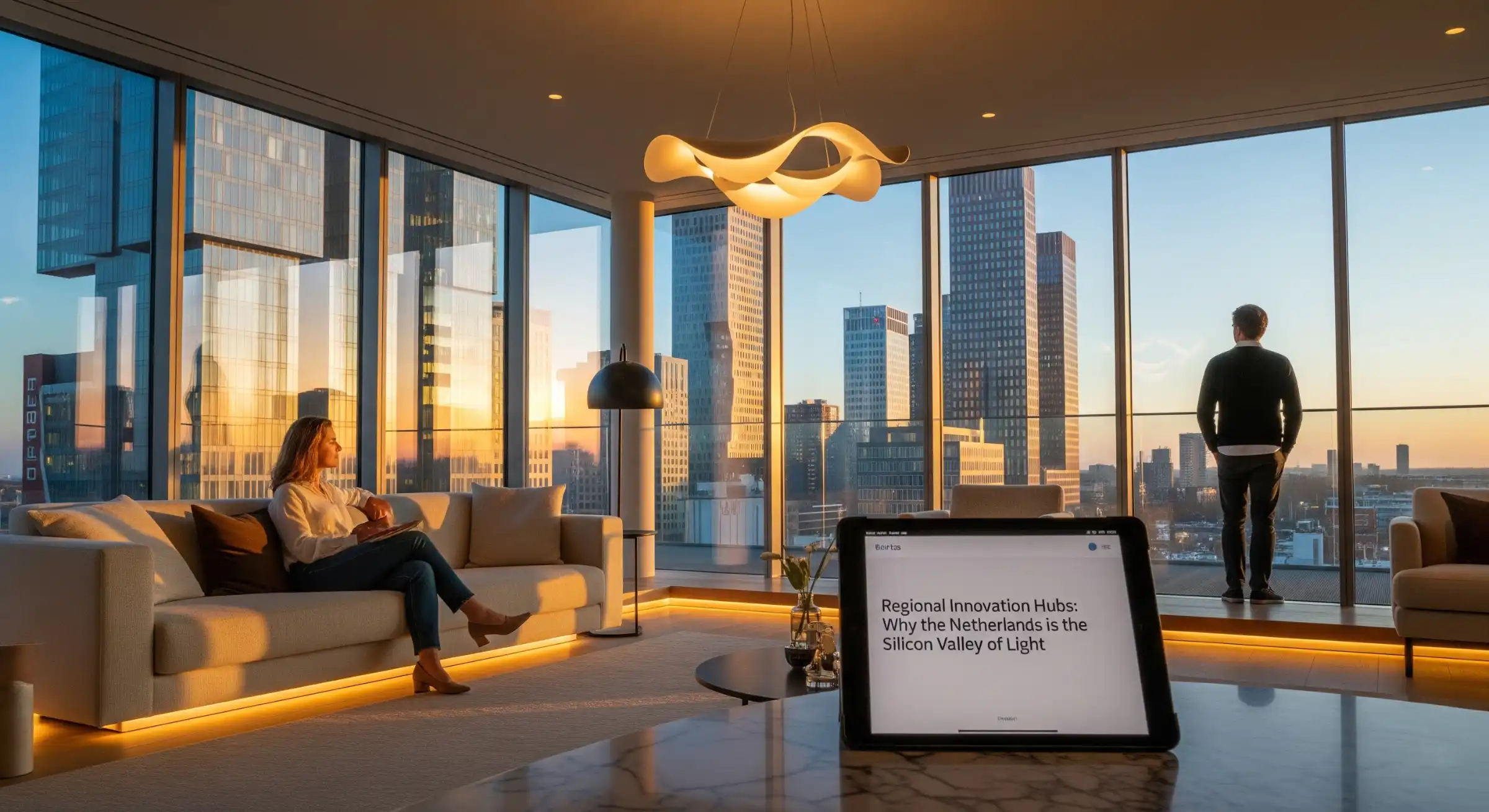
If you look at a satellite map of Europe at night, the Netherlands looks like a glowing circuit board. It’s no accident. While the rest of the world was busy making 'brighter' bulbs, the Dutch were busy making 'smarter' light. In 2026, the Netherlands has solidified its position as the Silicon Valley of Light—a regional innovation hub where history, tech, and art collide to create what we call 'Spatial Poetry.'
Today, we’re taking a 10-minute tour through the cities that are rewiring our world, from the industrial roots of Eindhoven to the architectural daring of Rotterdam.
1. Eindhoven: The 'City of Light' OG
You can't talk about Dutch light without starting in Eindhoven. This is where the Philips legacy began, but in 2026, it has moved far beyond the traditional lightbulb. Eindhoven is now the home of the GLOW Festival, an annual event where the entire city becomes a laboratory for Kinetic Art and AI-driven illumination.
- The Innovation: The High Tech Campus in Eindhoven is where the Matter protocol was stress-tested for residential use. They aren't just designing lamps; they are designing the 'nervous system' of the 2026 home.
Watch the Spectacle: Highlights of GLOW Eindhoven (YouTube)
2. Rotterdam: The Architectural Frontier
If Eindhoven is the brain, Rotterdam is the muscle. Known for its 'Main Character Energy' in architecture, Rotterdam uses light to breathe life into its industrial skeleton. The Fenix Museum for Migration is a world-class example of 'Light in Layers,' where designers use localized pools of light to tell a human story within a massive steel structure.
- The Lesson: Rotterdam teaches us that lighting should be 'sculptural'. In 2026, we don't hide the light; we make it part of the building's soul.
3. Amsterdam: The Floating Gallery
Amsterdam has mastered the art of 'Water-Reflected Light.' The Amsterdam Light Festival has pushed the boundaries of how light interacts with natural elements. This has led directly to the Biophilic Design trend we see in home interiors today—using rippled glass and organic forms to mimic the movement of the canals.
Watch the Art: Amsterdam Light Festival Behind the Scenes (YouTube)
4. Delft and Utrecht: The Science of Wellness
In the labs of TU Delft, researchers are perfecting Human-Centric Lighting (HCL). They are the ones proving the science behind our Circadian Rhythm guides. Meanwhile, Utrecht is leading the way in Circular Economy initiatives, creating fixtures from upcycled bio-waste like mushroom mycelium and citrus peels.
5. Beyond the Borders: Stockholm and Paris
While the Netherlands is the hub, the innovation spreads fast. Stockholm Design Week remains the center for 'Honest Minimalism,' while Paris continues to lead in 'High-End Artistry' through brands like Ozone.
Regional Implementation: A Renter's Guide
Living in one of these innovation hubs usually means living in a historic (and often protected) rental. How do you bring the Silicon Valley of Light into an old Amsterdam canal house or a Stockholm flat?
- Go Wireless: Don't drill into those 18th-century beams. Use Matter-certified portable lamps to create the Rotterdam 'layered' look.
- Respect the Dark: Follow the Dark Sky ethics pioneered in Dutch ecological zones—use shielded fixtures for your balcony or garden.
Visual Search Tip: Inspired by a floating installation in Amsterdam or a kinetic sculpture from Eindhoven? Take a screenshot and upload it to our AI Visual Search tool. We’ll find you a residential-grade, Matter-compatible match that brings the Dutch innovation hub directly into your living room.