Get personalized lamp recommendations for every room

Most people treat lamp shopping the same way they treat buying a throw pillow: pick something that looks nice and move on. But the lamp you choose shapes how a room actually feels to live in, not just how it photographs. Poor lighting flattens a space, strains your eyes, and quietly drains your mood without you ever connecting the dots. The right lamp, placed thoughtfully, can make a cramped bedroom feel like a retreat or a dull home office feel energizing. This guide covers how to match lamps to each room, what renter-friendly options actually work, and how to balance energy efficiency with beautiful light.
Table of Contents
- What does lamp recommendation mean?
- Room-by-room lamp recommendations
- Lamp recommendations for renters
- Balancing energy efficiency and lighting quality
- Our take: Why lamp recommendations are more than just décor advice
- Get personalized lamp recommendations for your home
- Frequently asked questions
Key Takeaways
| Point | Details |
|---|---|
| Balancing style and function | The best lamp recommendations blend aesthetics with practical lighting needs for each room. |
| Layered lighting is essential | Using multiple lamp types and placements creates coziness and helps avoid under-lighting. |
| Flexibility for renters | Portable, plug-in, and stick-on lamps meet renter needs while preserving walls and layout options. |
| Energy-efficient choices | LED lamps and dimmers save energy and provide customizable lighting quality. |
What does lamp recommendation mean?
A lamp recommendation is not simply “buy this one because it looks good.” It is a judgment that weighs room function, existing light sources, your personal style, and the kind of atmosphere you want to create. As lamp recommendations balance style, lighting function, and practical needs, every good suggestion starts with purpose before aesthetics.
There are two main camps when it comes to choosing lamps. Some people prioritize function over style, while others view lamps almost entirely as decor. Neither approach is wrong, but leaning too far in either direction creates problems. A stunning arc floor lamp that casts only dim, diffused light will frustrate you every time you try to read under it. A clinical, bright task lamp in your living room will feel cold and unwelcoming when you want to relax.
The comparison below shows how the two priorities play out in real decisions:
| Priority | Focus | Common risk | Best for |
|---|---|---|---|
| Function first | Brightness, coverage, task support | Feels sterile or mismatched | Offices, kitchens, study areas |
| Style first | Aesthetic, shape, color | Insufficient light for daily tasks | Accent areas, bedrooms, entryways |
| Balanced | Both comfort and look | Requires more research | Every room, ideally |
A strong lamp recommendation accounts for all of the following factors:
- Room type: A bedroom needs soft, dimmable light. A kitchen needs bright, shadow-free coverage.
- Lighting layer: Is this lamp providing ambient, task, or accent light?
- Lamp mobility: Will you move it between rooms or keep it fixed?
- Bulb type: The bulb determines color temperature and energy use. Start with choosing lamp bulbs before you lock in a fixture.
- Interior style: Your lamp should feel at home with your furniture and the lighting for interior design styles already in the space.
Once you know what you need from a lamp, the actual product search becomes far less overwhelming.
Room-by-room lamp recommendations
Every room has a different job to do, which means every room needs a different lighting strategy. A one-size-fits-all approach leads to spaces that feel either over-lit or dim in all the wrong places. The most effective approach, supported by expert layered lighting advice, is to think in layers: ambient light for general brightness, task light for focused activities, and accent light for mood and visual interest.
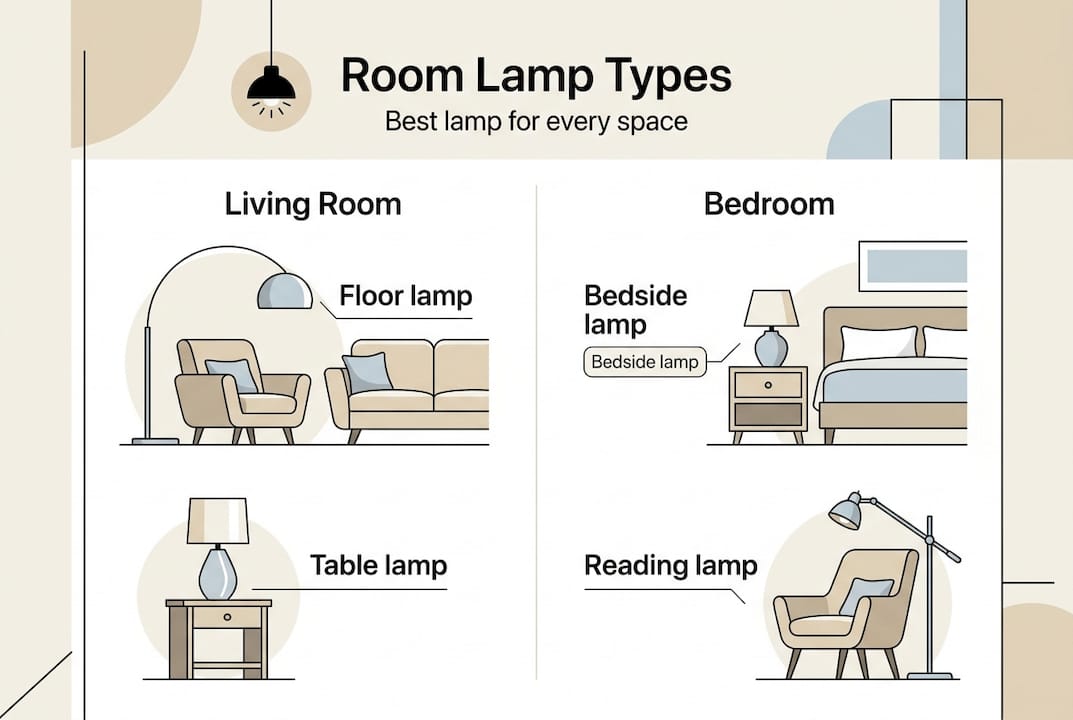
Room-specific lamp choices include floor and table lamps for living rooms, adjustable warm bedside lamps for bedrooms, and task lighting for kitchens and offices. The table below breaks this down by room:
| Room | Ideal lamp types | Recommended placement |
|---|---|---|
| Living room | Floor lamp, table lamp, arc lamp | Corners, beside sofa, near shelving |
| Bedroom | Bedside table lamp, reading lamp | Nightstands, dresser corners |
| Kitchen | Pendant, under-cabinet task lamp | Over island, beneath upper cabinets |
| Home office | Adjustable desk lamp, task lamp | Desk surface, monitor-adjacent |
You can explore curated options by space, including living room lamps, bedroom lamps, and kitchen lamps to get a feel for what works in each context.
Before buying anything, run through these steps to spot gaps in your current setup:
- Walk into the room and turn off every light source. Note which areas feel completely dark.
- Turn on only your overhead light. See where shadows fall on your work or reading surfaces.
- Identify which activities happen in the room and whether the light currently supports them.
- Check whether you have all three layers: ambient, task, and accent. Use this room lighting guide as a reference.
- Make a list of gaps and match each one to a lamp type before shopping.
For a deeper look at how to combine light sources intentionally, the layered lighting guide is a useful starting point.
Pro Tip: In living rooms and bedrooms, use lamps in pairs or sets of three placed at different heights. This creates visual symmetry and makes the space feel noticeably warmer and more intentional, even in a small apartment.
Lamp recommendations for renters
Renting a home comes with a specific constraint most lighting guides ignore: you cannot drill into walls, hardwire fixtures, or make permanent changes without risking your security deposit. That rules out a lot of traditional lighting solutions. But it does not mean you are stuck with one buzzing overhead bulb per room.
Renters should use plug-in, battery-powered, and stick-on lighting to avoid permanent installation. The good news is that the market for renter-friendly lighting has grown significantly, and there are solid options in nearly every style category.
Here are the lamp types that work best for renters:
- Plug-in floor lamps: These are the workhorses of renter lighting. They deliver significant ambient and task light with zero installation. A tall arc lamp in a living room corner can transform the feel of the entire space.
- Plug-in wall sconces: These mount with a small bracket and plug into a standard outlet, giving the look of hardwired lighting without any commitment.
- Battery-powered or rechargeable sconces: Fully wireless, these can go anywhere including spots without an outlet nearby. Useful above beds or in hallways.
- Stick-on puck lights and strip lights: Great for under-cabinet task lighting in kitchens or for accent lighting along shelves.
- String lights: Underrated for creating ambient warmth in living rooms and bedrooms, especially layered with a floor lamp.
For a full breakdown of what works and what does not, the no-drill lighting guide covers installation-free options in detail. You can also browse portable options in the living room lamps collection.
Pro Tip: Use at least three separate light zones in any room, even a small one. A floor lamp in one corner, a table lamp on a surface, and a rechargeable sconce on a wall creates dimension that a single overhead light simply cannot match.
Consistency still matters even when all your lamps are portable. Matching lamp heights and coordinating finishes across the room gives it a pulled-together look that makes the space feel designed rather than improvised.
Balancing energy efficiency and lighting quality
Choosing a lamp is not just about how a room looks at night. It also affects your electricity bill and the long-term quality of light in your home. The two goals, efficiency and quality, do not have to conflict. With the right bulb and fixture pairing, you can have both.

LED bulbs are the clear starting point. They use 80% less energy and last 25 times longer than traditional incandescent bulbs. Dimmable fixtures are present in more than half of well-designed spaces, giving you flexibility to shift from bright task mode to relaxed ambient mode without changing a single bulb.
When evaluating any lamp for energy efficiency, look for these features:
- LED compatibility or LED-included: Avoid lamps that only accept halogen or incandescent bulbs.
- Dimmable design: Pairing a dimmable lamp with a compatible LED bulb gives you a wide range of output without waste.
- Tunable color temperature: Some LED bulbs let you shift from warm white (2700K) for evenings to cool white (4000K) for daytime work.
- Appropriate lumen output: More lumens means more brightness. Match the output to the room’s needs rather than defaulting to the brightest option.
For guidance on pairing bulbs to fixtures, choosing lamp bulbs explains the key specs in plain terms. You can also browse energy-efficient lamp options for fixtures that prioritize low consumption.
“The biggest lighting mistake homeowners make is buying a beautiful fixture and then putting the wrong bulb in it. The bulb determines everything: color, warmth, glare, and efficiency. Get the bulb right first.”
Glare is a commonly overlooked problem. A bulb that is too bright for a small lamp shade creates harsh shadows and eye strain. Choosing a frosted or diffused bulb, or one with a lower lumen count in intimate spaces, solves this immediately.
Our take: Why lamp recommendations are more than just décor advice
Here is something the interior design world rarely says plainly: most people are not bad at style, they are simply under-informed about function. We have seen beautiful, expensive spaces that feel oddly cold and uncomfortable, not because the furniture is wrong, but because the lighting layers are missing.
The conventional approach is to pick a lamp that matches the sofa or the wall color and call it done. But thoughtful lamp placement, using the layered lighting perspective as a starting framework, changes how a space feels at a neurological level. Warm, layered light signals safety and comfort to your brain. Flat, single-source light keeps you slightly on edge, even if you cannot explain why.
For renters especially, lighting is the single highest-return upgrade available. Paint is often off the table. New flooring is out of the question. But three well-chosen lamps can make a generic rental apartment feel personal and warm within an hour.
“Lighting is not finishing. It is the foundation. Everything else in a room is a reaction to how the light behaves.”
The most practical thing you can do is stop treating lamps as an afterthought and start selecting them with the same intentionality you give to furniture.
Get personalized lamp recommendations for your home
Knowing what to look for is only the first step. Finding the actual lamp that fits your room, your style, and your budget is where most people get stuck.
Find a Lamp makes that process faster and more accurate with AI tools that analyze your room’s style, layout, and lighting needs. Upload a photo of your space and get curated suggestions tailored to what you actually have, not just generic picks. Browse by room with the living room lamp collection or the bedroom lamp collection, or use the visual search to find lamps similar to ones you already love. The platform also lets you visualize how a lamp will look in your specific space before you commit to buying it.
Frequently asked questions
How many lamps should I use in a living room?
Experts recommend at least four lamps per living room to create a cozy, layered lighting effect, since most homes are significantly under-lit.
What is the best lamp for renter-friendly spaces?
Portable, plug-in, battery-powered, or stick-on lamps are ideal because they require no drilling and can be moved or removed without damaging walls.
How do I avoid color temperature clashes between lamps?
Choose bulbs with a consistent warm temperature across all lamps in the same room, typically between 2700K and 3000K, to maintain a harmonious feel.
Are LED lamps really more efficient?
Yes. LED lamps use 80% less energy and can last 25 times longer than traditional incandescent bulbs, making them the practical choice for every room.