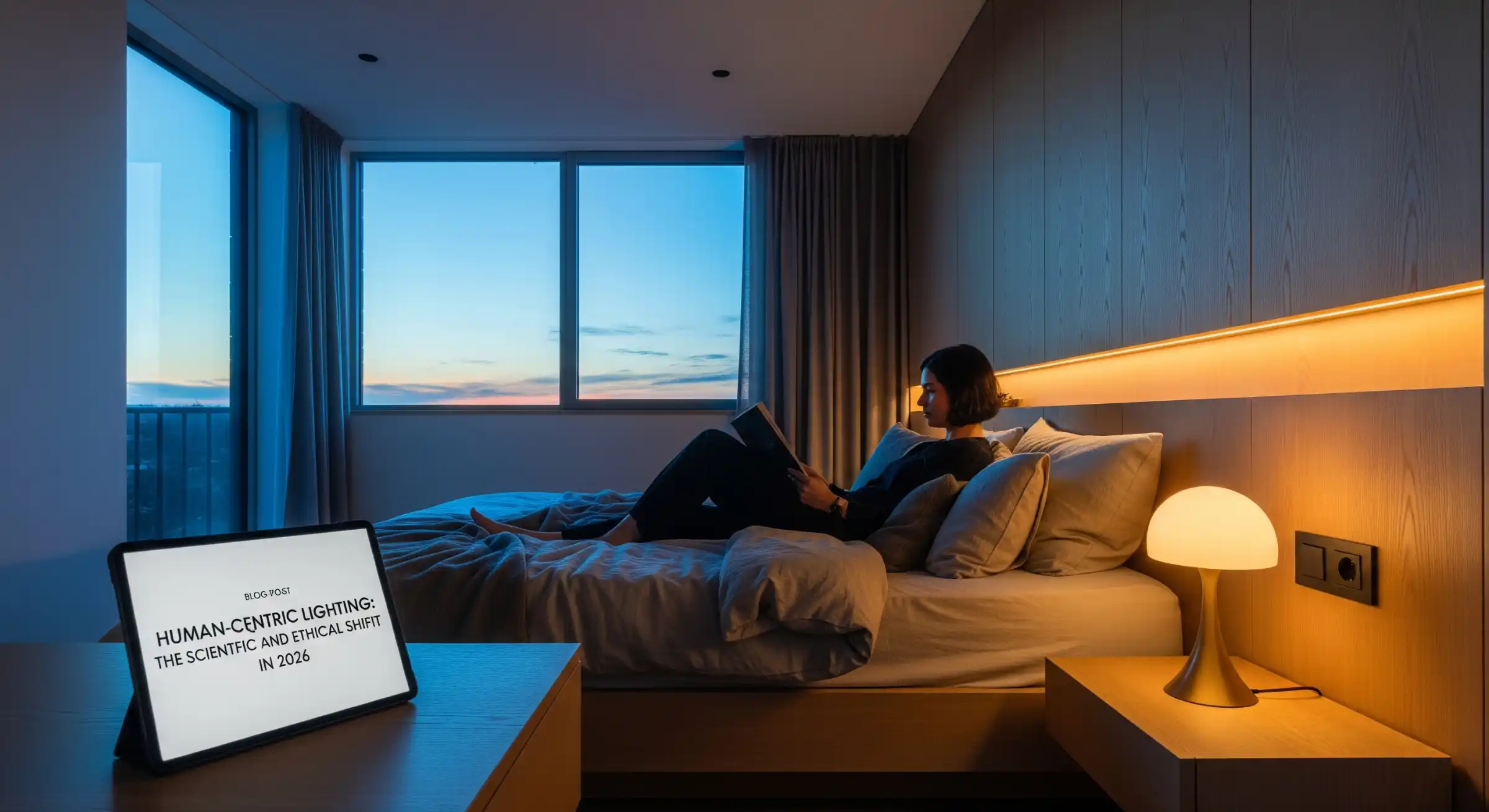
We’ve all heard the advice: 'Put your phone away before bed.' But why? If you’ve been following the health-tech space lately—perhaps listening to the Huberman Lab podcast or reading up on 'Biohacking'—you know that photons are essentially a drug. In 2026, the lighting industry has finally moved beyond the 'Interrogation Era' of static blue LEDs and into the era of Human-Centric Lighting (HCL).
This isn't just about 'mood lighting' anymore. It is a scientific and ethical shift that treats light as a human right and a biological necessity. Let’s dive into the 10-minute masterclass on why your home needs a 'Biological Glow-Up'.
1. The Science: Hacking Your Circadian Rhythm
At the core of HCL is the circadian rhythm—the internal 24-hour clock that regulates everything from your energy levels to your digestion. Your eyes contain specialized cells called ipRGCs that don't help you see, but instead tell your brain what time it is based on the blue content of the light.
- Morning (The Cortisol Kick): High-intensity, 5000K+ light mimics the high sun. It suppresses melatonin and triggers cortisol, making you feel alert. This is where the 'Big Light' is actually allowed.
- Evening (The Melatonin Bridge): As the sun sets, we need a shift to Warm-Dim (2200K - 2700K). This signals the brain to start wind-down protocols.
Watch the Science: How Light Affects Your Brain (YouTube)
2. The Ethical Shift: Light as a Right, Not a Luxury
In 2025/2026, designers are looking at the Ethics of Illumination. This covers two main areas: Light Equity and Ecological Stewardship. Leading firms are now winning LIT Awards for projects that prioritize 'The Right to Darkness'.
The International Dark-Sky Association has influenced global standards (like the LUNA V2.0 we covered recently). The ethical argument is simple: excessive, unshielded light is a pollutant that disrupts local ecosystems and human sleep cycles. A 'good' 2026 fixture doesn't just illuminate your room; it protects the world outside your window.
3. The Invisible Architect: Matter and Automation
How do you manage all this science without feeling like you're working a second job as a lighthouse keeper? The answer is the Matter protocol.
By 2026, the 'app chaos' of the past has been replaced by seamless interoperability. You can now set a Circadian Routine that automatically transitions your lights from 'Productivity White' to 'Golden Hour Amber' without you ever touching a switch. It’s the ultimate Tech-Enabled Artisan move: using high-end software to achieve a low-stress, natural life.
4. The Material Connection: Biophilic Art
The philosophy of HCL is also driving the Organic Modern aesthetic. If we want light that mimics nature, the lamp itself should feel natural. We are seeing a surge in fixtures using 'Hyper-Tactile' materials like translucent alabaster or 3D-printed filaments that mimic organic cell structures. It’s about making the technology invisible and the experience emotional.
5. Ethical Implementation: The Checklist
- Choose 90+ CRI: Color accuracy is part of biological comfort. A low-CRI bulb makes your home look 'sickly'; a high-CRI bulb makes it look 'alive'.
- Shield Your Bulbs: Avoid direct glare. Use fabric, frosted glass, or paper shades to diffuse light, protecting your eyes and your neighbors'.
- Go Local: Use Matter-certified systems to ensure your home works locally (offline), protecting your data privacy and ensuring reliability.
Visual Search Tip: Seen a biomorphic 'sun lamp' or a high-tech circadian system on a design blog? Take a screenshot and upload it to our AI Visual Search tool. We’ll find you a Matter-ready match that brings the science and ethics of 2026 lighting into your sanctuary.