How Visual Search Is Transforming Lighting Selection

Picture this: You’re scrolling through Pinterest, your eyes alight on the *perfect* pendant light for your kitchen island. It’s sleek, it’s chic, it’s exactly what you’ve been dreaming of. But then reality hits. How do you find it? You try keywords: "black minimalist pendant," "modern kitchen light," "geometric chandelier." You scroll, you click, you get lost in a sea of "almosts" and "not-quites." Sound familiar?
That frustrating loop of keyword guessing, endless scrolling, and ultimately settling for something generic has defined lighting shopping for far too long. But guess what? Those days are officially over. Thanks to the magic of AI-powered visual search, that stunning fixture you saw on Instagram, in a boutique hotel, or even at a friend's house is now just a photo away from being yours. By uploading a single image, homeowners can now identify matching or near-identical fixtures in under a second, with 96% faster search results compared to manual browsing. Welcome to the future of lighting discovery!
This isn't just a minor upgrade; it's a complete revolution in how we source and select lighting. This guide will walk you through exactly how to harness that power, from understanding the cutting-edge technology behind it to choosing the right tools and squeezing out the best possible results for your space. Get ready to transform your lighting selection experience effortlessly!
Table of Contents
- Why Visual Search Matters for Lighting Inspiration
- How AI-Powered Visual Search Tools Work for Home Lighting
- Specialized vs. General Visual Search: What’s the Difference?
- Real-World Results: How Much Faster and More Accurate Is Visual Search?
- Tips for Getting the Best Results from Lighting Visual Search
- The Hidden Power of Visual Search: Why It’s More Than Just a Shortcut
- Ready to Discover Your Perfect Light? Try Visual Search Today
- Frequently Asked Questions
Key Takeaways
| Point | Details |
|---|---|
| Visual search saves time | AI tools cut lighting selection from minutes to seconds for homeowners. |
| Accurate and personalized matches | Visual search delivers up to 95% match accuracy by reading style and finish details. |
| Photo quality is critical | Clear, well-lit photos lead to better and more creative lighting matches. |
| Specialized tools outperform generic apps | Tools built for lighting handle fixture nuances that general visual search often misses. |
| Anyone can design like a pro | Visual search empowers all homeowners to bring design ideas to life affordably. |
Why Visual Search Matters for Lighting Inspiration
Having set the context for why old lighting search feels outmoded, let’s break down what makes visual search a game-changer for homeowners and design lovers alike. It's not just about speed; it's about unlocking a new level of design freedom and precision.
The traditional approach to finding a statement chandelier or a moody bedside sconce involved keyword guessing, style labels that often meant different things to different catalogs, and an exhausting amount of tab-switching. You’d try "industrial pendant light," then "farmhouse chandelier," then "modern rustic fixture," hoping to stumble upon something close. Visual search eliminates this frustrating translation layer entirely. You see a fixture you love – in a restaurant, a design blog, a friend’s living room, or a glossy magazine – and you search with the image itself. No need to decipher complex design vocabulary; the image speaks for itself.
What makes this particularly exciting for design enthusiasts is the directness of the connection. Visual search revolutionizes lighting discovery for homeowners by building an intuitive pipeline from inspiration to purchase, especially for people browsing aesthetics on social platforms. The algorithm doesn’t just look for a “black pendant” — it reads silhouette complexity, material texture, proportional scale, and ambient diffusion style simultaneously. This means it understands the *vibe* you’re going for, not just the basic descriptors.
Here’s what visual search genuinely unlocks for the inspired homeowner:
- Direct Inspiration-to-Product Flow: Screenshot a fixture from any social media platform, a digital magazine, or even snap a quick photo in real life, and search immediately. No keyword translation needed, just pure visual matching.
- Beyond Keywords: Style and Function Recognition: AI distinguishes between a warm-diffusing globe pendant and a sharp-shadow industrial cage, two very different lighting moods housed in similar forms. It understands the subtle differences in materials like brushed brass versus polished chrome, or frosted glass versus clear.
- Rare and Niche Fixture Discovery: Searching for an unusual Art Deco sconce with fluted glass, a specific mid-century modern chandelier, or a unique Scandinavian design? Visual search surfaces options that keyword terms would never capture. It dives deep into catalogs to find those hidden gems.
- Personalized Browsing Experience: Because the tool understands your uploaded aesthetic, results align precisely with your taste rather than a generic popularity ranking. It learns what you like, refining its suggestions over time.
- Breaking Down Design Jargon Barriers: Not everyone is fluent in "Bauhaus," "Boho Chic," or "Industrial Loft." Visual search eliminates the need for a design dictionary, allowing you to communicate your vision simply by showing it. As Architectural Digest often emphasizes, lighting is a key element of design, and visual search makes it accessible to everyone.
“The moment you stop searching with words and start searching with images, you stop compromising on design and start finding what you actually envisioned.”
That shift, from approximating your vision in text to presenting it visually, is where the creative energy lives. It’s the difference between describing a song and playing it – you instantly *get* it.
How AI-Powered Visual Search Tools Work for Home Lighting
Now that you see the creative value, let’s peek behind the curtain at how these AI tools actually operate — and why that’s empowering for design, not intimidating.
At the heart of every visual search tool is a sophisticated piece of technology called a convolutional neural network (CNN). Think of a CNN as a super-smart visual detective. Instead of just looking at the overall picture, it reads images layer by layer, identifying intricate details: first, simple edges and lines; then, basic shapes and textures; and finally, complex spatial relationships and entire objects. For lighting specifically, the AI is trained on hundreds of thousands, if not millions, of fixture images, each meticulously tagged with attributes like pendant vs. flush-mount, matte vs. polished finish, warm vs. cool light diffusion, organic vs. geometric form, and even historical period. When you upload a photo, the model extracts a unique visual “fingerprint” from your image and compares it against its vast catalog in milliseconds, finding the closest matches.
Here’s how the process works from your perspective as a user:
- Source Your Inspiration Image: This is the fun part! Pull a screenshot from Pinterest, Instagram, or a design magazine. Photograph a stunning fixture in a hotel lobby, a restaurant, or a friend’s living room. Any reasonably sharp photo will work as your starting point.
- Upload to the Visual Search Tool: With a single tap, your image is sent to the AI. Immediately, the system scans for fixture characteristics: its scale relative to the room (if visible), its silhouette type (e.g., globe, linear, caged), its finish tonality (e.g., warm gold, cool silver, rustic bronze), and its overarching stylistic language (e.g., modern, traditional, industrial).
- Review the Matched Results: AI tools like Find a Lamp surface fixtures matching on multiple attributes simultaneously, not just basic shape. You’ll see near-identical options alongside creative alternatives that share key design elements, allowing you to explore variations of your initial inspiration.
- Refine with Filters: The initial results are just the beginning. Use intuitive category filters to narrow your search by room type (e.g., dining room, bedroom), finish, size, price range, or even specific brands. Most specialized tools allow progressive refinement without re-uploading, making the discovery process seamless.
- Visualize in Your Space (Advanced Platforms): Some advanced platforms even offer augmented reality (AR) features that overlay selected fixtures onto a photo of your actual room. This incredible feature allows you to validate scale, check the ambiance, and ensure the fixture perfectly complements your existing decor before making a purchase.
One area where this technology performs remarkably well is in rooms with distinct design languages. Shopping for modern dining and kitchen lighting works especially well with visual search because the AI can distinguish between a minimalist linear suspension and a warm mid-century globe cluster — two very different fixtures that might both appear under a generic “dining pendant” keyword search. Similarly, if you’re styling a child’s space and have a specific fixture in mind, searching visually for playful bedroom lighting surfaces results that actually match the whimsical, scaled-down aesthetic you’re envisioning, rather than just any "kids' lamp."
Pro Tip: Crop your inspiration photo tightly around the fixture before uploading. Removing distracting background furniture, wall colors, or other elements helps the AI focus its analysis exclusively on the light itself, yielding more precise and relevant matches. For a deeper dive into how AI processes images, check out this explanation of image recognition technology.

| Feature | AI visual search | Manual keyword search |
|---|---|---|
| Search time | Under 1 second | 15 to 20 minutes |
| Attribute recognition | Multi-layered (shape, finish, scale, mood, material) | Limited to text labels |
| Handles rare fixtures | Yes, with high accuracy | Rarely, often misses nuances |
| Result personalization | High, based on visual input | Low, based on general keywords |
| Requires design vocabulary | No, visual input is enough | Yes, precise terms needed |
Specialized vs. General Visual Search: What’s the Difference?
Understanding how these tools work leads naturally to a practical question: should you use a dedicated lighting search tool, or will a general app like Google Lens or Pinterest Lens do the job?
Both have a role, but they serve fundamentally different purposes. Specialized tools are built specifically for decorative lighting, which means they account for the intricate nuances that matter most for chandeliers, pendants, and sconces. They understand canopy types, arm configurations, shade geometries, the warmth of a frosted glass diffuser versus a clear glass one, and how these elements contribute to a fixture's overall style and function. General tools, while impressive in their broad capabilities, simply don’t carry that level of category-specific intelligence.
General visual search tools like Google Lens and Pinterest Lens are genuinely useful for early-stage inspiration: identifying a broad style, discovering a designer’s name, or linking to a mood board. They analyze color, shape, and contextual environment effectively. For instance, if you snap a photo of a living room, they might suggest furniture, rugs, or paint colors. But when you need to find a replacement sconce that perfectly matches three others already on your wall, or source a specific Art Nouveau pendant for a renovation project, those broad tools frequently return irrelevant home decor pages, lifestyle imagery, or even completely unrelated products rather than shoppable lighting fixtures.
Here’s when to reach for each type of tool:
- Use specialized lighting visual search when:
- You have a specific fixture style in mind and need shoppable matches from a curated catalog.
- The fixture is unusual, architectural, or highly styled (think sculptural or glam dining and kitchen lighting).
- You need matches within a defined catalog with precise filters for price, size, finish, and light source.
- You’re sourcing for a renovation or a room where consistency and exact matching across fixtures are critical.
- You want to avoid the "noise" of irrelevant results and get straight to lighting options.
- Use general visual search when:
- You’re very early in the inspiration phase and exploring broadly across many home decor categories.
- You want to identify a designer, brand, or aesthetic movement of a general item in a photo, not necessarily a specific product.
- You’re building a mood board without an immediate purchase intent, and general visual cues are sufficient.
- You need to identify text, landmarks, or plants in an image.
For a room with a more classical sensibility, specialized tools surface results within the right aesthetic language. Searching for traditional dining and kitchen lighting through an AI-trained catalog means the results carry the right silhouette weight, finish warmth, and period-appropriate details that a generic image engine simply won’t prioritize. It's the difference between asking "what kind of light is this?" and "show me where I can buy *that specific light* or something incredibly similar."
| Criterion | Specialized lighting search | General visual search |
|---|---|---|
| Fixture detail accuracy | Very high, understands lighting nuances | Moderate, focuses on broad shapes/colors |
| Shoppable results | Yes, directly from curated catalogs | Often indirect, may link to general blogs |
| Style nuance (pendants, sconces) | Excellent, recognizes specific forms | Limited, may group dissimilar styles |
| Inspiration breadth | Moderate, focused on lighting products | Very broad, covers all visual elements |
| Best use case | Targeted fixture finding & purchasing | Early-stage exploration & general info |
Pro Tip: Use both in sequence for the ultimate design power. Start with Pinterest Lens or Google Lens to explore a broad visual direction or identify a general style. Once you’ve narrowed down to a specific fixture you love, upload that favorite image into a specialized tool like Find a Lamp’s AI visual search to find the actual purchasable product that matches your mood board!
Real-World Results: How Much Faster and More Accurate Is Visual Search?
We've talked about the "how" and the "why," but what do the numbers say? Here’s how visual search actually performs when put to the test in the demanding world of home decor and lighting.
The data is striking and consistently impressive. In a furniture and home decor visual search study, search time plummeted from an average of 18 minutes to an astonishing 0.8 seconds. That’s a 96% reduction in time spent hunting for the right product! Furthermore, match accuracy soared to 95%, meaning users were overwhelmingly satisfied with the relevance of the results. For design professionals, the impact is equally profound: designer hours required to source products fell by an average of 90%. These are not marginal improvements; they represent a fundamental, game-changing shift in how quickly and effectively good design decisions can happen.
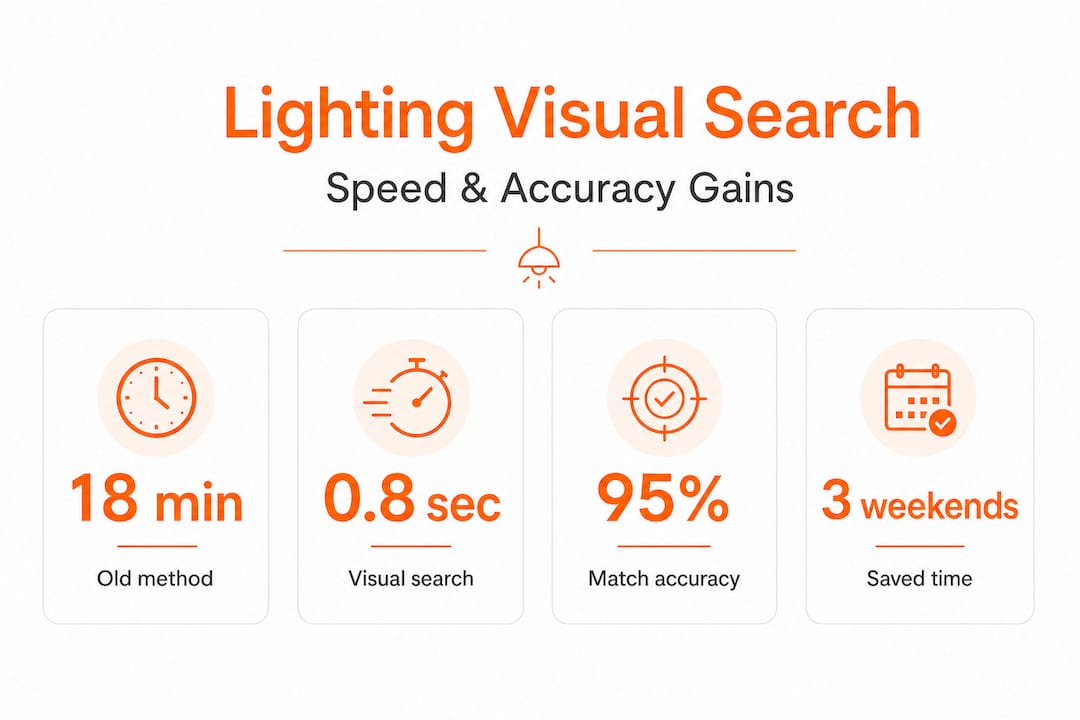
What does that mean practically for you, the homeowner? A person who previously spent three frustrating weekends sourcing the right light fixture for their living room can now accomplish the same task in a single afternoon, complete with visual confirmation of how the fixture looks in their actual space. Imagine reclaiming that precious time! This drastic reduction in search time also significantly reduces decision fatigue, allowing you to approach your design choices with fresh eyes and renewed energy.
| Metric | Before visual search | After visual search |
|---|---|---|
| Average search time | ~18 minutes | ~0.8 seconds |
| Match accuracy | Variable/subjective, often frustrating | Up to 95%, highly reliable |
| Designer hours (sourcing) | High, significant time investment | Reduced by 90%, freeing up creative time |
| User satisfaction | Often frustrated, prone to settling | Consistently higher, leads to confident choices |
| Decision fatigue | High, can delay projects | Significantly reduced |
The creative implications extend well beyond mere convenience. When sourcing time collapses, the energy that was once spent hunting shifts to curating, comparing, and refining. Homeowners can iterate through three or four serious fixture candidates in the time it previously took to find one. That’s a creative multiplier that leads to truly exceptional results. The speed and accuracy empower you to explore more options, compare them rigorously, and ultimately make a choice you'll genuinely love for years to come. For more insights into the impact of visual search in retail, a Forbes article on visual search in e-commerce offers a broad perspective.
For rooms where lighting defines the entire atmosphere, like modern living room lighting setups where a single statement piece anchors the whole aesthetic, that speed and accuracy genuinely changes the quality of the final design decision. You’re no longer settling; you're truly curating.
Tips for Getting the Best Results from Lighting Visual Search
These incredible benefits are easiest to unlock if you know how to use visual search tools the right way. Think of it as providing the AI with the clearest possible instructions – the better your input, the more spot-on its output will be.
Even the most sophisticated AI performs better with thoughtful inputs. Think of your inspiration photo as a creative brief: the more clearly it communicates what you want, the more precisely the tool can respond. Here are the most impactful practices to adopt:
- Choose Well-Lit, Clutter-Free Photos: The AI reads every element in the frame. A lamp photographed against a clean, neutral background yields far cleaner results than one buried in a busy room vignette. Natural daylight or even, consistent artificial light is your best friend here. Avoid harsh shadows or overexposed areas.
- Crop Tightly to the Fixture: This is crucial! Remove as much surrounding furniture, wall art, and extraneous decor as possible. Narrowing the frame tells the AI exactly what you’re searching for, preventing it from getting distracted by other objects in the image.
- Try Multiple Angles (if available): A pendant photographed straight-on reads differently from one shot at a slight angle, or one that shows its suspension mechanism. If you have several photos of the same fixture from different perspectives, upload them all. This can surface a wider range of complementary options and help the AI understand the 3D form.
- Use Style Filters After Uploading: Don't just accept the initial results. After the AI provides its first set of matches, use the refinement filters within the tool. Dial in specific preferences for finish (e.g., matte brass, polished chrome, antique bronze), size, room type, color, or even price range to zero in on your ideal match. These filters are powerful tools for personalization.
- Acknowledge the Limitations (and work around them): While incredibly advanced, AI isn't magic. Specialized AI outperforms general tools on category-specific details, but both types still struggle with extremely low-light images, heavily shadowed photos, or blurry, pixelated shots. If a nighttime photo isn’t working, try to find a daytime version of the same fixture online, or look for a clearer, professional image.
- Consider the Context of the Inspiration Photo: If the fixture is part of a larger design, try to understand the overall aesthetic of the original image. This will help you use the refinement filters more effectively. For example, if it's a sleek, minimalist space, you'll want to filter for modern finishes and simple forms.
The payoff for getting the input right is substantial. If you’re styling something expressive, like artistic bedroom lighting with sculptural form and layered ambiance, a precise image helps the AI understand whether you’re drawn to organic biomorphic forms or structured geometric architectures. Similarly, for lighter, more energetic spaces, searching for playful living room lighting with a clean, well-lit inspiration image will yield results that actually capture the specific whimsy and scale you’re after, rather than just generic "bright" options.
Pro Tip: Before embarking on a room design project, save a dedicated folder of your best inspiration images. Organize them by room and lighting zone (ambient, task, accent). This organized library becomes a powerful, reusable asset every time you return to search, streamlining your entire design process.
The Hidden Power of Visual Search: Why It’s More Than Just a Shortcut
We’ve walked through the mechanics and the impressive metrics, but there’s a larger story here that we feel strongly about sharing. Visual search is not just a faster way to shop; it's a profound shift in how we approach interior design.
Visual search is often framed purely as a convenience feature, a faster on-ramp to the same shopping destination. That fundamentally undersells what it does. In our view, it’s a democratizing force. Not long ago, translating a bold or unusual design vision into actual purchasable lighting required either direct access to professional designers, an encyclopedic knowledge of fixture manufacturers and their catalogs, or hours upon hours of frustrating manual searching. That specialized knowledge was expensive to acquire and even more expensive to hire.
Now, anyone with a smartphone and a clear photo of a fixture they admire has access to the same discovery speed and accuracy that used to be reserved for seasoned sourcing professionals. Visual search benchmarks show high ROI across the board, but the deeper return isn’t measured in dollars or minutes saved alone. It’s measured in design confidence.
When you know you can search freely and find real, purchasable options quickly, you stop self-censoring your taste. You stop defaulting to the “safe” beige drum shade because you couldn’t figure out how to find that sculptural rattan pendant you actually wanted. The creative range of a room expands dramatically because the friction of finding something exceptional has been significantly removed. This newfound confidence empowers you to take creative risks and explore styles you might have previously thought were out of reach. As interior designers often note, lighting is the jewelry of the home, and visual search allows everyone to choose their perfect gems.
That freedom is most visible when homeowners pursue unexpected aesthetic directions. If you’re drawn to the raw character of industrial lamps, visual search doesn’t require you to already know the term “Edison-style cage pendant” or "steampunk fixture" — you simply show the tool an image that captures the feeling, and it does the rest. It removes the language barrier between your visual inspiration and the product world.
Design is a visual language. It always has been. Visual search just finally gave us