How to choose the right lamp for every room efficiently

Dim corners, harsh overhead glare, a stylish lamp that somehow makes the room feel worse — most people have lived through at least one of these lighting disasters. The truth is, picking a lamp by looks alone almost always leads to disappointment. The right lamp does two things at once: it supports what you actually do in that room and it fits the space like it belongs there. This guide walks you through every step, from analyzing your room’s lighting needs to reading specs, sizing lamps correctly, and matching them to your decor — so every purchase feels intentional, not accidental.
Table of Contents
- Understand your space and lighting needs
- Match lamp specs to function
- Get proportions and placement right
- Balance style, decor, and efficiency
- Our perspective: The real-world art of lamp selection
- Find your perfect lamp — quickly and confidently
- Frequently asked questions
Key Takeaways
| Point | Details |
|---|---|
| Match lamp to function | Always choose a lamp based on the specific needs of the room and activity for effective results. |
| Check specs, not watts | Focus on lumens, color temperature, and CRI to get the right brightness and mood, not just wattage. |
| Proportion is essential | Proper lamp height and shade size create comfort and balanced design in any space. |
| Prioritize efficiency | Opt for LED and ENERGY STAR lamps to save energy and money over time without sacrificing quality. |
Understand your space and lighting needs
Before you buy anything, you need to understand what your room is actually asking for. Not every space needs the same kind of light, and treating them all the same is one of the most common mistakes homeowners make.
Lighting generally falls into three categories. Ambient lighting is the base layer — it fills the room with general, even light. Task lighting is focused and bright, designed to support specific activities like reading, cooking, or working at a desk. Accent lighting is the dramatic one — it highlights artwork, architectural features, or decorative objects. Most well-lit rooms use all three together.
Start by walking through each room and asking: what do I actually do here, and where does the light feel wrong? Common needs include:
- Reading nooks and home offices: Need focused task lighting that reduces eye strain
- Living rooms: Benefit from layered ambient and accent lighting for entertaining or relaxing
- Bedrooms: Require soft, warm ambient light plus a task lamp for nighttime reading
- Dining areas: Work best with dimmable ambient light that shifts from functional to atmospheric
- Display shelves or art walls: Call for accent lighting to draw the eye
Once you map out those needs, the room-by-room lighting guidance approach becomes much clearer. For example, living room lamps often need to serve multiple roles across a single evening, while bedroom lamp options tend to prioritize warmth and calm over raw brightness.
The key factors for lamp selection include purpose, room type, scale, lighting specs like lumens and Kelvin, style, and energy efficiency — and they all work together, not in isolation.
Layered lighting strategy: Combine ambient, task, and accent sources in every room, then add dimmers so you can shift the mood without changing a single bulb. This approach gives you maximum flexibility with minimal effort.
Think of layered lighting as a volume dial for your room’s atmosphere. You’re not locked into one mood — you’re building a system.
Match lamp specs to function
Once you know what each room needs, the next step is understanding the numbers behind the light. Specs aren’t just technical jargon — they directly affect how comfortable, productive, and relaxed you feel in a space.
Lumens measure brightness. Watts measure energy use. With LEDs now standard, watts no longer tell you how bright a bulb is.
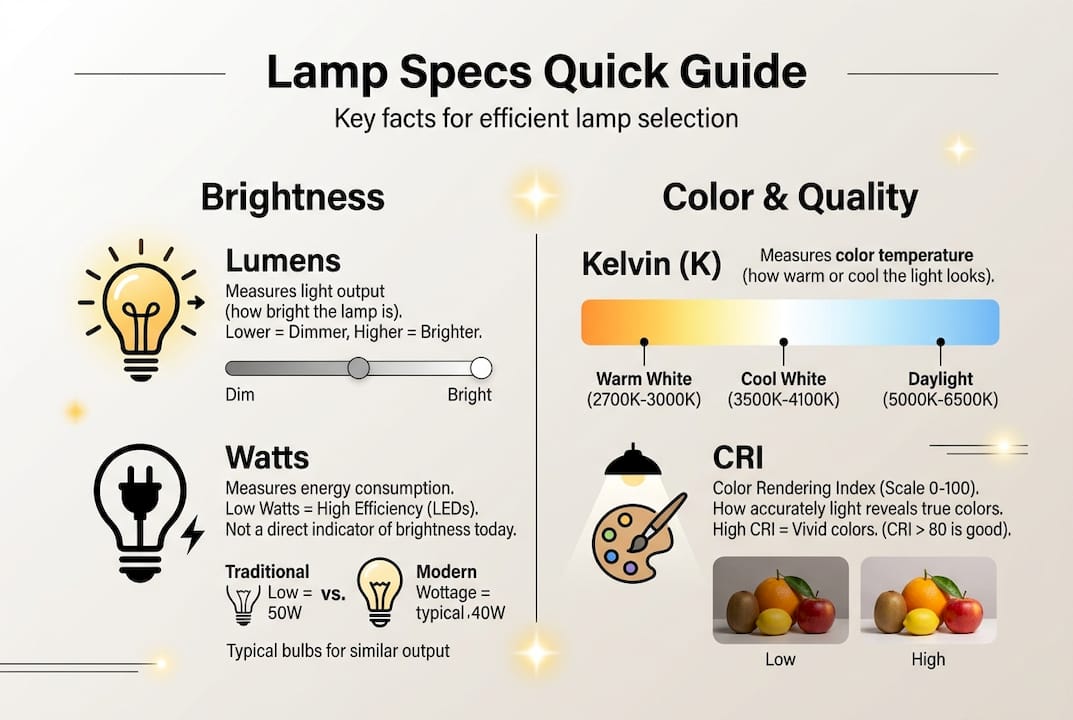
Pro Tip: Always shop by lumens, not watts. For LED bulbs, 800 lumens replaces a traditional 60-watt incandescent. Reading and task lamps typically need 400 to 800 lumens for comfortable focus.
Color temperature is measured in Kelvin (K). Lower numbers (2700K to 3000K) produce warm, yellowish light that feels cozy and relaxed — perfect for bedrooms and living rooms. Higher numbers (4000K to 5000K) produce cool, bluish-white light that boosts alertness — better for home offices and kitchens.
CRI (Color Rendering Index) measures how accurately a light source shows the true colors of objects. A CRI of 90 or above is ideal for spaces where color matters, like a home studio, makeup vanity, or anywhere you display art.
Here’s a quick reference to guide your decisions:
| Room or purpose | Lumens needed | Color temp (Kelvin) | CRI priority |
|---|---|---|---|
| Living room | ~20 lumens per sq ft | 2700K to 3000K | 80+ |
| Reading lamp | 400 to 800 | 2700K to 3000K | 85+ |
| Home office / desk | 1000 to 1400 | 3500K to 4500K | 80+ |
| Kitchen task area | 700 to 1000 | 3000K to 4000K | 85+ |
| Bedroom ambient | 300 to 500 | 2700K | 80+ |
Before buying, run through this checklist:
- Identify the primary activity in the room (reading, relaxing, working, cooking)
- Check the room’s square footage and calculate lumens needed
- Choose a Kelvin range based on mood vs. task requirements
- Confirm CRI is appropriate for color-sensitive activities
- Verify the lamp accepts LED bulbs if it doesn’t come with one
The prioritize specs over style first principle is one that experienced designers follow but rarely talk about. Get the function right, then layer in the aesthetics.
For style-specific shopping, browse traditional living room lighting, modern living room lighting, traditional bedroom lighting, or modern bedroom lighting once your specs are locked in.
Get proportions and placement right
A lamp with perfect specs can still look completely wrong if it’s the wrong size for the space. Proportion is one of those things you feel before you can explain it — and getting it wrong creates a room that just feels off.
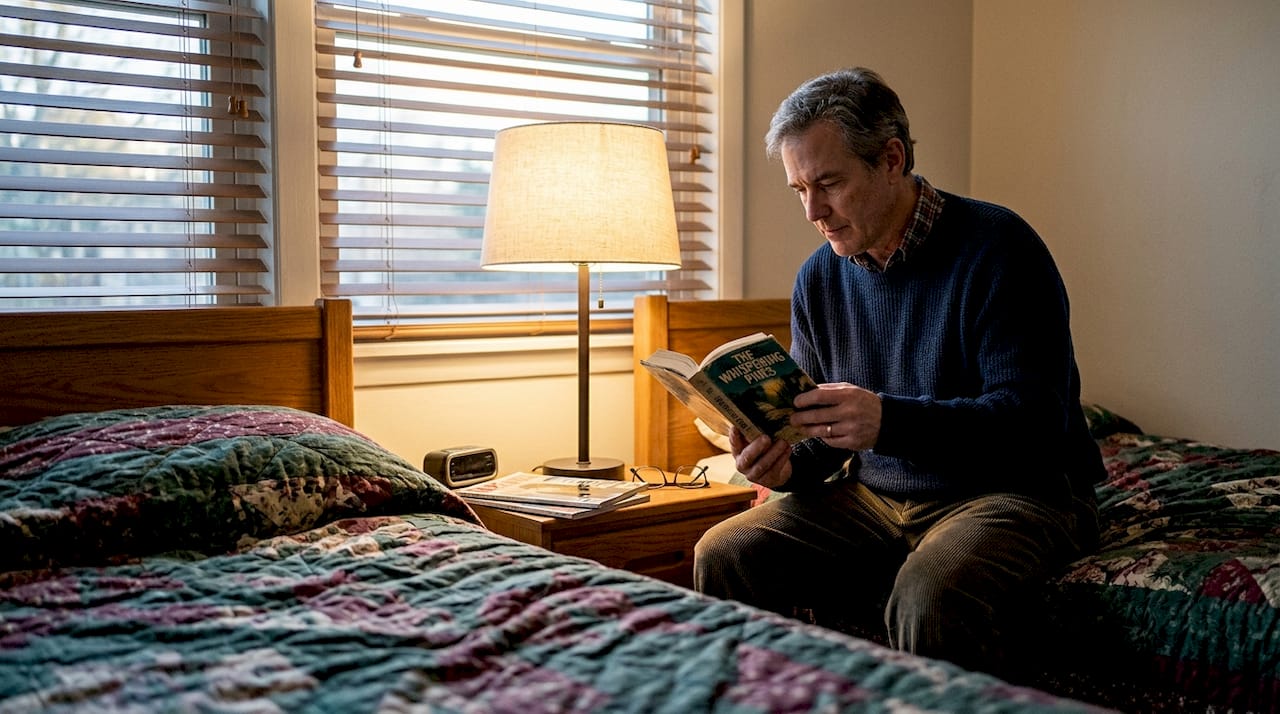
For table lamps, the general rule is that the shade’s bottom edge should sit at eye level when you’re seated. That usually means a lamp between 24 and 36 inches tall for living rooms and bedrooms. The shade diameter should be roughly two-thirds the width of the surface it sits on — so a 12-inch wide nightstand works best with a shade around 8 inches wide.
Here’s how good and poor proportions compare in real spaces:
| Scenario | Good proportion | Poor proportion |
|---|---|---|
| Bedside table lamp | 26-inch lamp, 8-inch shade on a 12-inch table | 36-inch lamp towering over a small nightstand |
| Living room floor lamp | 58 to 65 inches tall beside a standard sofa | 48-inch lamp that sits below seated eye level |
| Desk task lamp | Adjustable arm reaching 15 to 20 inches above desk | Fixed lamp that casts shadow over work area |
| Entryway console lamp | Lamp height = roughly 1.5x console height | Squat lamp that disappears on a tall console |
Before you commit to a purchase, test the size with these steps:
- Measure the table or surface width and calculate two-thirds for the ideal shade diameter
- Sit in the chair or on the bed where you’ll use the lamp and measure your eye level
- Use a cardboard box or stack of books as a stand-in to simulate the lamp’s height
- Step back and look at the setup from across the room — not just up close
- Check that the cord reaches an outlet without stretching across a walkway
Pro Tip: If you’re a renter, plug-in floor and table lamps are your best friends. They require zero drilling, move with you, and still deliver the layered lighting effect that lighting for different design styles recommends for every type of interior.
Balance style, decor, and efficiency
Now that function and fit are sorted, it’s time to make sure your lamp actually looks like it belongs in the room. Style coordination isn’t about matching everything perfectly — it’s about creating visual harmony.
Start by identifying your room’s dominant design language. Then look for lamps that share at least one or two of its characteristics: material, finish, shape, or color palette.
- Minimalist and Scandinavian spaces: Clean lines, matte finishes, neutral tones, natural wood or metal bases
- Mid-century modern rooms: Tapered shades, brass or walnut accents, geometric silhouettes
- Industrial interiors: Exposed bulbs, matte black or gunmetal finishes, cage-style shades
- Traditional and classic decor: Ceramic or crystal bases, pleated fabric shades, warm metallic finishes
- Bohemian and eclectic spaces: Woven shades, earthy tones, layered textures, mismatched but intentional combinations
Beyond looks, efficiency should be a serious part of your decision. LEDs use 75 to 90% less energy than incandescent bulbs, last 15,000 to 50,000 hours, and the average household saves $225 per year by switching. That’s not a small number over five years of living in a space.
Look for the ENERGY STAR label when shopping for LED lamps or replacement bulbs. It signals that the product has been independently tested for efficiency, light quality, and longevity — not just marketed that way.
For renters, stylish plug-in lamps solve two problems at once: they look intentional and they move with you. Check out renter-friendly lighting tips for ideas that work in any lease situation without leaving a mark.
Our perspective: The real-world art of lamp selection
Here’s something most lighting guides won’t tell you: the majority of people get the process backwards. They fall in love with a lamp’s look, buy it, and then wonder why the room still feels wrong. Style is the last decision, not the first.
After seeing hundreds of lighting setups, the pattern is consistent. Rooms that feel genuinely well-lit almost always started with a function-first approach. The homeowner asked “what does this room need to do?” before asking “what looks cool?”
The mockup step in the proportions section is one that almost nobody does — and it’s the single most effective way to avoid a costly mistake. A cardboard box costs nothing. A lamp you can’t return costs real money and real frustration.
For renters especially, flexible lighting is not a compromise. It’s actually a creative advantage. You’re not locked into fixed fixtures, which means you can experiment, reposition, and explore renter lighting solutions that a homeowner with hardwired fixtures simply can’t.
Test proportions with mockups, avoid low-CRI bulbs in any room where color accuracy matters, and treat plug-in lamps as a design feature rather than a workaround.
The best lamp for your room is the one that works every single day — not just the one that photographs well.
Find your perfect lamp — quickly and confidently
You now have a clear framework: identify the room’s function, match specs to that function, size the lamp correctly, and coordinate with your existing style. The knowledge is there. The next step is putting it into action without spending hours scrolling through endless options.
Find a Lamp combines AI-powered recommendations with virtual visualization tools, so you can upload a photo of your room and see exactly how a lamp will look before you buy. Whether you’re after playful living room options that add personality or need to browse desk lamps for a focused home office setup, the platform matches your specific needs to curated products — no guesswork required.
Frequently asked questions
What is the best brightness level for a reading lamp?
A reading lamp should deliver 400 to 800 lumens for comfortable, eye-friendly light. For more demanding tasks, up to 1,400 lumens may be appropriate.
How do I choose a lamp that fits my room’s style?
Match the lamp’s shape, finish, and color to your room’s dominant design elements. Style matching decor is one of the key factors in making a lamp feel like it belongs rather than just filling a corner.
Are LED lamps worth the cost?
Absolutely. LEDs save 75 to 90% of the energy used by incandescent bulbs, last far longer, and reduce annual electricity costs by an average of $225 per household.
What lamp size should I use for my bedside table?
Aim for a lamp between 24 and 28 inches tall, with a shade diameter roughly two-thirds the width of your nightstand for balanced, proportional lighting.
Recommended
- Room Lighting Guide: Living Room, Kitchen, Bedroom & More - Find a Lamp - Find a Lamp
- Lighting for Your Style: Modern, Industrial, Rustic & More - Find a Lamp - Find a Lamp
- Lamps for Living Room - Find a Lamp
- Traditional Living Room Lighting – Find a Lamp
- 6 Essential LED Lighting Tips for Businesses to Save Costs