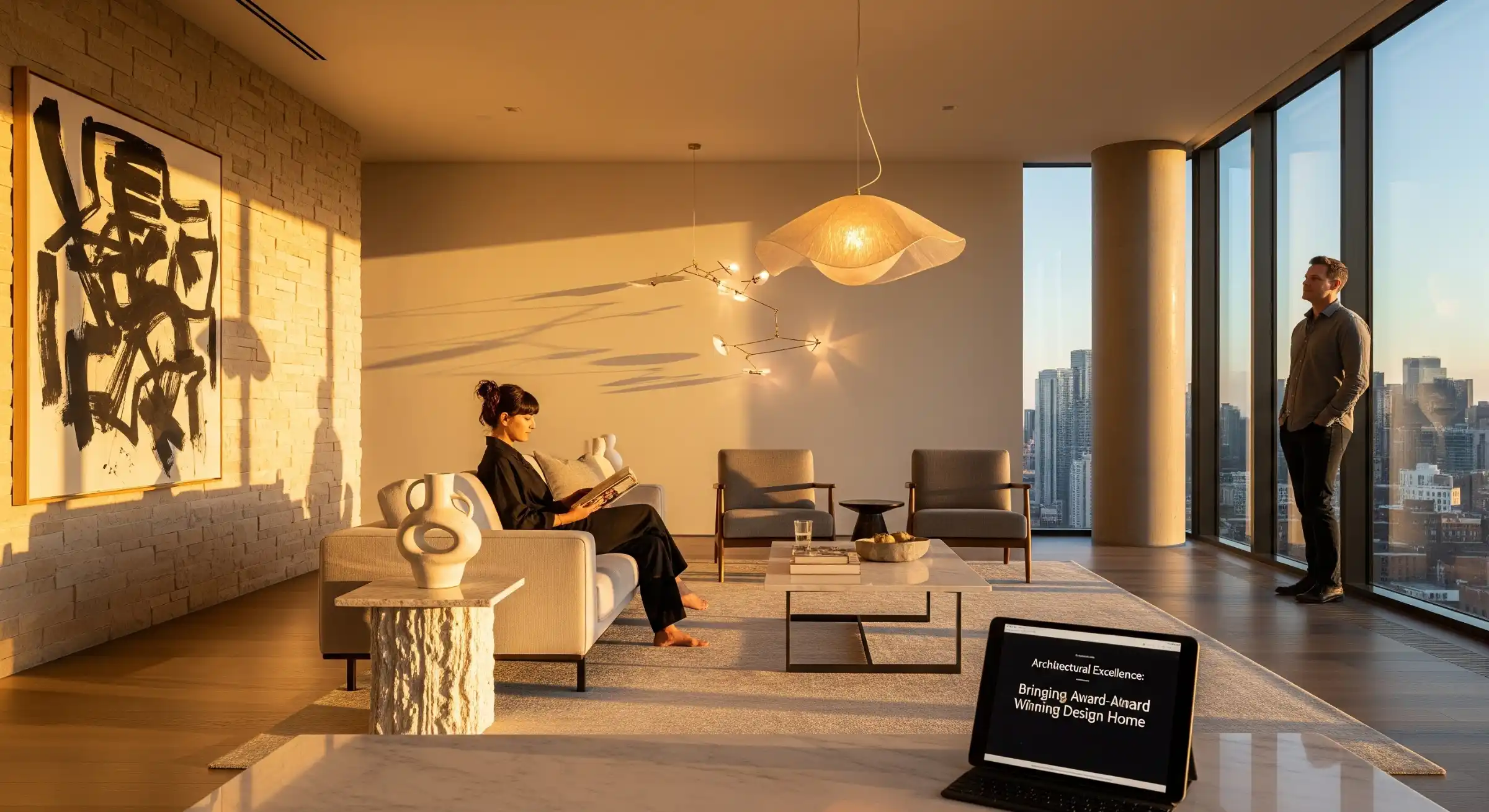
If you’ve ever binged an Architectural Digest 'Open Door' tour and wondered why those celebrity homes feel so much more 'expensive' than yours, here is a secret: it’s almost never the furniture. It’s the lighting choreography. In 2026, the world’s most prestigious design circles—from the LIT Lighting Design Awards to the Dezeen Awards—are celebrating projects that treat light as an invisible building material.
Today, we’re looking at the winners of the last season and extracting the 'Museum Quality' secrets you can use to transform your own space from a standard room into a curated sanctuary.
1. The Masterclass in Layers: The Fenix Museum, Rotterdam
One of the most talked-about projects of the year is the Fenix Museum for Migration. Designed by Atelier(s) Alfonso Femia with lighting by Artec Studio, this project is the gold standard for 'Light in Layers.' Instead of blasting the historic industrial site with floodlights, the designers used localized 'pools' of light to guide visitors through the narrative.
- The Lesson: Don't try to light your whole room from one source. Use the 'Museum Method'—light your artwork, your coffee table, and your pathways separately. It creates the 'Visual Tension' that makes a space feel high-end.
2. Biomorphic Brilliance: Davidpompa and the Shell Revolution
Designers like Davidpompa are currently winning accolades for their focus on Material Ecology. During the latest design weeks, Pompa unveiled fixtures made from discarded shells and volcanic rock. This isn't just about 'looking natural'; it’s about the Hyper-Tactility of the light itself.
When light hits a raw, irregular surface like a shell or unpolished stone, it diffuses in a way that mimics the dappled sunlight of a forest. This is the heart of Biophilic Design—bringing the restorative patterns of nature indoors. If you want to see this in action, check out the Contramar project in Mexico City.
3. The Kinetic Shift: Moving Beyond the Static
The LIT Awards winners this year have one thing in common: movement. Whether it’s the kinetic Totem de Luz or motorized 'sun' fixtures, light is no longer a static utility. We are seeing a demand for fixtures that 'dance' or change with the time of day.
This theatrical energy is a direct trickle-down from global entertainment tours. The same precision used to light a stage is now available for your home via Matter-certified smart systems that allow for 'Choreographed Scenes'.
4. Why High-CRI is the Celebrity Secret
Ever notice how art in a gallery looks more 'real'? That is the power of the Color Rendering Index (CRI). Architectural excellence depends on bulbs with a CRI of 95 or higher. High-end designers never compromise on this because a low-CRI bulb will make a $20,000 travertine floor look like cheap linoleum. In 2026, 'museum-quality whites' are a standard home requirement.
Watch the Expert Breakdown: Why Lighting is the Most Important Part of Architecture (YouTube)
5. How to Recreate 'Excellence' on a Budget
You don't need a museum budget to get the look. Follow the 2026 'Artisan' checklist:
- Texture Over Chrome: Choose matte, stone, or paper finishes that diffuse light rather than reflecting it harshly.
- The 3:1 Rule: Your 'Accent' light (the one on your art or plant) should be three times brighter than your 'Ambient' light.
- Warm-Dim: Ensure your bulbs shift to an amber hue as they get lower, mimicking the biological signal of the sunset.
Visual Search Tip: Found a project on the Dezeen longlist or the Top 100 Lighting Partners list that you love? Take a screenshot and upload it to our AI Visual Search tool. We’ll find you a 98% match that brings architectural excellence into your living room tonight.